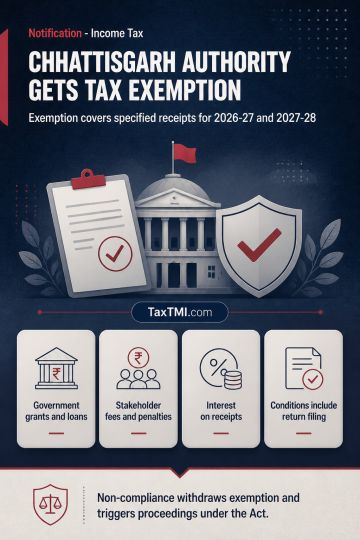
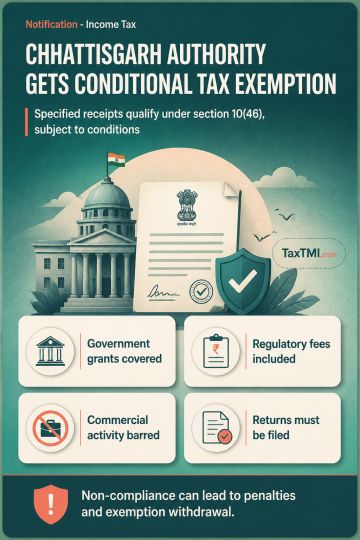
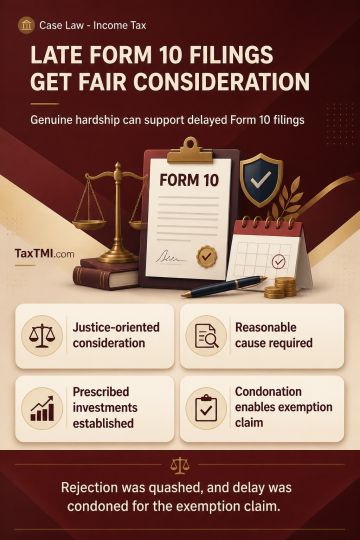
Specified regulatory authority income receives conditional tax exemption, subject to non-commercial activity, unchanged income character, and return f...
Tax exemption for regulatory authority income applies retrospectively, subject to non-commercial activity, unchanged income sources, and return-filing...
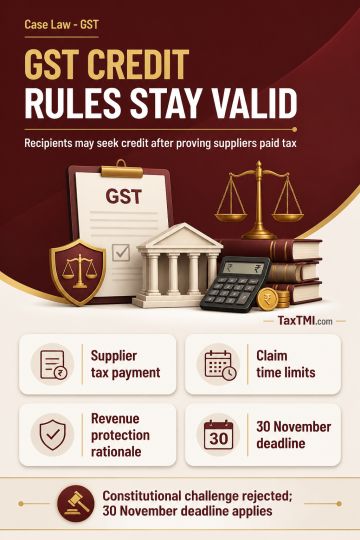
Input tax credit conditions remain constitutionally valid, with eligible recipient claims considered under GST circulars and retrospective filing dead...
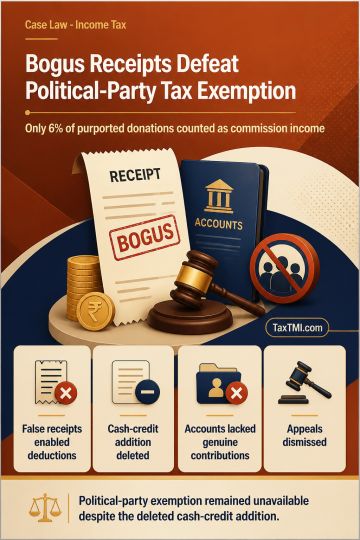
Bogus donation receipts justified commission income assessment and defeated political-party tax exemption for inaccurate accounts and reporting failur...
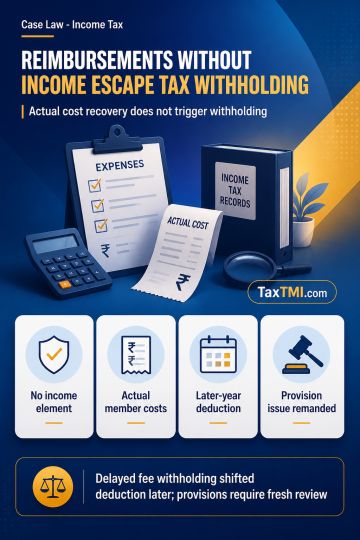
Pure reimbursement without income element escapes tax withholding, while delayed withholding and unsupported provisions face deferred or renewed scrut...
Public benefit requirement defeats charitable registration where residents' association services are reciprocal, member-only facilities governed by mu...
The case pertains to the revision of an assessment order u/s 263 regarding the applicability of the higher tax rate u/s 115BBE on unexplained expenditure u/s 69C. The assessee had purchased excess stock using unexplained funds, which the Assessing Officer (AO) treated as unexplained expenditure but charged tax at normal rates. The Principal Commissioner of Income Tax (PCIT) invoked Section 263, contending that the higher tax rate u/s 115BBE should have been applied. However, the Tribunal held that when the AO has conducted proper inquiries and taken a plausible view, the PCIT cannot substitute their view for the AO's unless the AO's view is unsustainable in law. The Tribunal relied on the Supreme Court's decision in Malabar Industrial Co. Ltd., which stated that every loss of revenue due to the AO's order cannot be treated as prejudicial to revenue interests u/s 263. If two views are possible and the AO has taken one view, it cannot be treated as an erroneous order unless the AO's view is unsustainable in law. Consequently, the Tribunal decided in favor of the assessee.
The case pertains to the revision of an assessment order u/s 263 regarding the applicability of the higher tax rate u/s 115BBE on unexplained expenditure u/s 69C. The assessee had purchased excess stock using unexplained funds, which the Assessing Officer (AO) treated as unexplained expenditure but charged tax at normal rates. The Principal Commissioner of Income Tax (PCIT) invoked Section 263, contending that the higher tax rate u/s 115BBE should have been applied. However, the Tribunal held that when the AO has conducted proper inquiries and taken a plausible view, the PCIT cannot substitute their view for the AO's unless the AO's view is unsustainable in law. The Tribunal relied on the Supreme Court's decision in Malabar Industrial Co. Ltd., which stated that every loss of revenue due to the AO's order cannot be treated as prejudicial to revenue interests u/s 263. If two views are possible and the AO has taken one view, it cannot be treated as an erroneous order unless the AO's view is unsustainable in law. Consequently, the Tribunal decided in favor of the assessee.
Note: It is a system-generated summary and is for quick reference only.
 TaxTMI
 of 4801










 Join Channel


 TaxTMI
