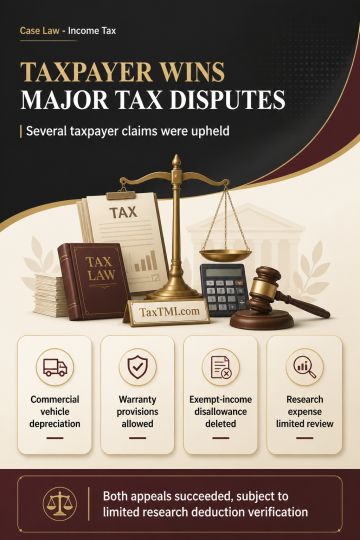
Commercial vehicle depreciation, scientifically determined warranty provisions and exempt-income disallowances were resolved in favour of the taxpayer...
Inherited property sale proceeds require capital-gains treatment where ownership is supported by evidence, not suspicion or unverified signature doubt...
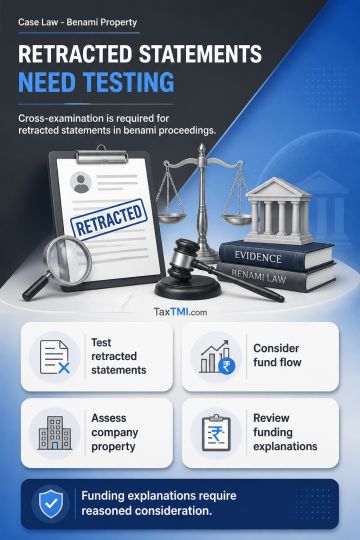
Cross-examination of retracted statements is essential where foundational evidence supports a benami allegation and documented funding explanations re...
Capital-goods exemption covers plant-modernisation accessories, while the import restriction applies only to earlier capital-goods components and spar...
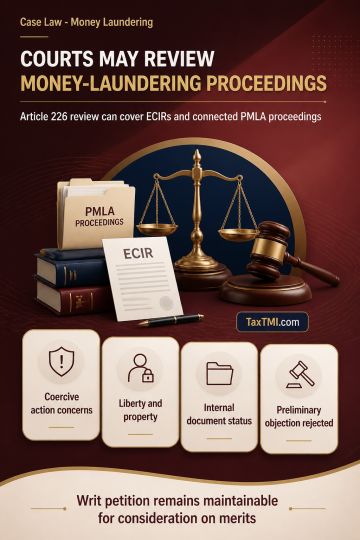
Constitutional judicial review permits challenges to ECIRs and connected money-laundering proceedings where coercive action affects fundamental intere...
The case pertains to the revision of an assessment order u/s 263 regarding the applicability of the higher tax rate u/s 115BBE on unexplained expenditure u/s 69C. The assessee had purchased excess stock using unexplained funds, which the Assessing Officer (AO) treated as unexplained expenditure but charged tax at normal rates. The Principal Commissioner of Income Tax (PCIT) invoked Section 263, contending that the higher tax rate u/s 115BBE should have been applied. However, the Tribunal held that when the AO has conducted proper inquiries and taken a plausible view, the PCIT cannot substitute their view for the AO's unless the AO's view is unsustainable in law. The Tribunal relied on the Supreme Court's decision in Malabar Industrial Co. Ltd., which stated that every loss of revenue due to the AO's order cannot be treated as prejudicial to revenue interests u/s 263. If two views are possible and the AO has taken one view, it cannot be treated as an erroneous order unless the AO's view is unsustainable in law. Consequently, the Tribunal decided in favor of the assessee.
The case pertains to the revision of an assessment order u/s 263 regarding the applicability of the higher tax rate u/s 115BBE on unexplained expenditure u/s 69C. The assessee had purchased excess stock using unexplained funds, which the Assessing Officer (AO) treated as unexplained expenditure but charged tax at normal rates. The Principal Commissioner of Income Tax (PCIT) invoked Section 263, contending that the higher tax rate u/s 115BBE should have been applied. However, the Tribunal held that when the AO has conducted proper inquiries and taken a plausible view, the PCIT cannot substitute their view for the AO's unless the AO's view is unsustainable in law. The Tribunal relied on the Supreme Court's decision in Malabar Industrial Co. Ltd., which stated that every loss of revenue due to the AO's order cannot be treated as prejudicial to revenue interests u/s 263. If two views are possible and the AO has taken one view, it cannot be treated as an erroneous order unless the AO's view is unsustainable in law. Consequently, the Tribunal decided in favor of the assessee.
Note: It is a system-generated summary and is for quick reference only.
 TaxTMI
 of 4796
















 Join Channel


 TaxTMI
