Prolonged sterilisation of development rights supports capital-gains treatment, while business-income disallowances cannot govern capital-gains comput...
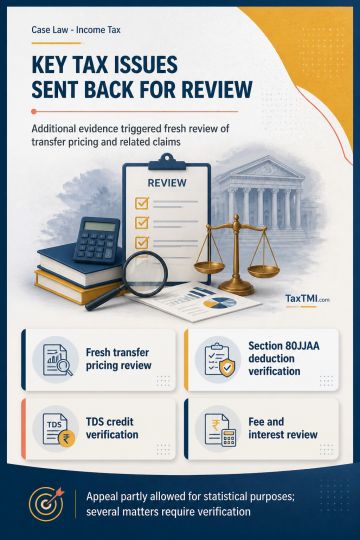
Additional evidence in transfer pricing dispute leads to fresh examination, while tax deductions, TDS credit, fee and refund interest require verifica...
Category II AIF pass-through taxation preserves non-business income character; investment receipts cannot be reclassified without applying recognised ...
Mutual fund maturity rules require proper rollover, redemption, disclosure, and due diligence; investor gains cannot excuse regulatory breaches or pen...
Threshold exemption excludes exempt services, while stamp-paper purchases avoid reverse charge; consequential service tax penalties were also set asid...
The case pertains to the addition of undisclosed income u/s 69A of the Income Tax Act, wherein the peak credit method was applied. The Commissioner of Income Tax (Appeals) [CIT(A)] was satisfied with the assessee's business activities and cash collections deposited in bank accounts. The CIT(A) reproduced the details of the peak credit, considering opening balances in bank accounts, cash, advances, income from money lending business, and drawings. The CIT(A) determined the unexplained amount after deducting the net fund available from the peak credit. The CIT(A) relied on the decision of the Madras High Court in the case of PCIT v. S. Anbukannan, which upheld the peak credit method for addition of undisclosed income, and the ITAT Chennai's order in the case of S. Kulanthaian, who is a relative of the assessee. The ITAT found no infirmity in the CIT(A)'s order and dismissed the Revenue's appeal.
The case pertains to the addition of undisclosed income u/s 69A of the Income Tax Act, wherein the peak credit method was applied. The Commissioner of Income Tax (Appeals) [CIT(A)] was satisfied with the assessee's business activities and cash collections deposited in bank accounts. The CIT(A) reproduced the details of the peak credit, considering opening balances in bank accounts, cash, advances, income from money lending business, and drawings. The CIT(A) determined the unexplained amount after deducting the net fund available from the peak credit. The CIT(A) relied on the decision of the Madras High Court in the case of PCIT v. S. Anbukannan, which upheld the peak credit method for addition of undisclosed income, and the ITAT Chennai's order in the case of S. Kulanthaian, who is a relative of the assessee. The ITAT found no infirmity in the CIT(A)'s order and dismissed the Revenue's appeal.
Note: It is a system-generated summary and is for quick reference only.
 TaxTMI
 of 4805


















 Join Channel


 TaxTMI
