Vicarious liability for dishonoured company cheques may extend to non-signatory directors where complaints contain foundational responsibility avermen...
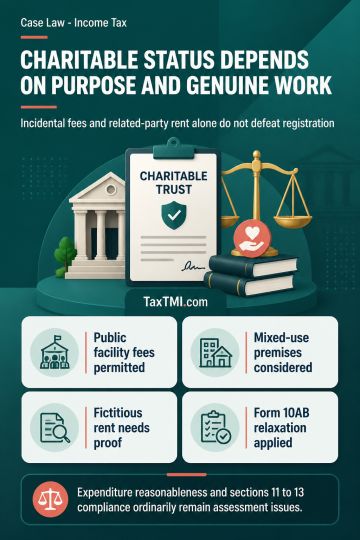
Charitable registration turns on predominant purpose and genuine activities, while incidental fees and related-party rent require supporting adverse m...
MAT book-profit adjustments exclude disallowances for exempt-income expenditure and demerger expenditure unless expressly listed under the statutory c...
The case pertains to the addition of undisclosed income u/s 69A of the Income Tax Act, wherein the peak credit method was applied. The Commissioner of Income Tax (Appeals) [CIT(A)] was satisfied with the assessee's business activities and cash collections deposited in bank accounts. The CIT(A) reproduced the details of the peak credit, considering opening balances in bank accounts, cash, advances, income from money lending business, and drawings. The CIT(A) determined the unexplained amount after deducting the net fund available from the peak credit. The CIT(A) relied on the decision of the Madras High Court in the case of PCIT v. S. Anbukannan, which upheld the peak credit method for addition of undisclosed income, and the ITAT Chennai's order in the case of S. Kulanthaian, who is a relative of the assessee. The ITAT found no infirmity in the CIT(A)'s order and dismissed the Revenue's appeal.
The case pertains to the addition of undisclosed income u/s 69A of the Income Tax Act, wherein the peak credit method was applied. The Commissioner of Income Tax (Appeals) [CIT(A)] was satisfied with the assessee's business activities and cash collections deposited in bank accounts. The CIT(A) reproduced the details of the peak credit, considering opening balances in bank accounts, cash, advances, income from money lending business, and drawings. The CIT(A) determined the unexplained amount after deducting the net fund available from the peak credit. The CIT(A) relied on the decision of the Madras High Court in the case of PCIT v. S. Anbukannan, which upheld the peak credit method for addition of undisclosed income, and the ITAT Chennai's order in the case of S. Kulanthaian, who is a relative of the assessee. The ITAT found no infirmity in the CIT(A)'s order and dismissed the Revenue's appeal.
Note: It is a system-generated summary and is for quick reference only.
 TaxTMI
 of 4792










 Join Channel


 TaxTMI
