Specialized Investment Fund distribution now requires dedicated certification, while transitional recognition preserves existing qualified distributor...
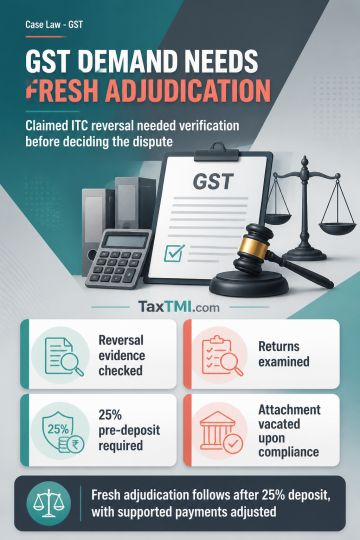
Overlapping GST proceedings require Central and State authorities to designate one competent authority for coordinated adjudication of the same matter...
Composite healthcare supplies retain exemption when patient care is the contract's essential character, despite payment through an implementing agency...
Page of 4801
Press 'Enter' after typing page number.
921 to 940 of 96001 Results
❮
❯
❯❯
0 / 200
Expand Note
Add to Folder
No Folders have been created
+
Are you sure you want to delete "My most important" ?
The case pertains to the addition of undisclosed income u/s 69A of the Income Tax Act, wherein the peak credit method was applied. The Commissioner of Income Tax (Appeals) [CIT(A)] was satisfied with the assessee's business activities and cash collections deposited in bank accounts. The CIT(A) reproduced the details of the peak credit, considering opening balances in bank accounts, cash, advances, income from money lending business, and drawings. The CIT(A) determined the unexplained amount after deducting the net fund available from the peak credit. The CIT(A) relied on the decision of the Madras High Court in the case of PCIT v. S. Anbukannan, which upheld the peak credit method for addition of undisclosed income, and the ITAT Chennai's order in the case of S. Kulanthaian, who is a relative of the assessee. The ITAT found no infirmity in the CIT(A)'s order and dismissed the Revenue's appeal.
The case pertains to the addition of undisclosed income u/s 69A of the Income Tax Act, wherein the peak credit method was applied. The Commissioner of Income Tax (Appeals) [CIT(A)] was satisfied with the assessee's business activities and cash collections deposited in bank accounts. The CIT(A) reproduced the details of the peak credit, considering opening balances in bank accounts, cash, advances, income from money lending business, and drawings. The CIT(A) determined the unexplained amount after deducting the net fund available from the peak credit. The CIT(A) relied on the decision of the Madras High Court in the case of PCIT v. S. Anbukannan, which upheld the peak credit method for addition of undisclosed income, and the ITAT Chennai's order in the case of S. Kulanthaian, who is a relative of the assessee. The ITAT found no infirmity in the CIT(A)'s order and dismissed the Revenue's appeal.
Note: It is a system-generated summary and is for quick reference only.
 TaxTMI
 of 4801



















 Join Channel


 TaxTMI