Transaction value rejection requires reliable corroboration; refundable VAT is excluded and temporary registration does not defeat new-vehicle exempti...
Appellate jurisdiction remains available where a wrist-worn gold ornament cannot conclusively be characterised as imported baggage at the preliminary ...
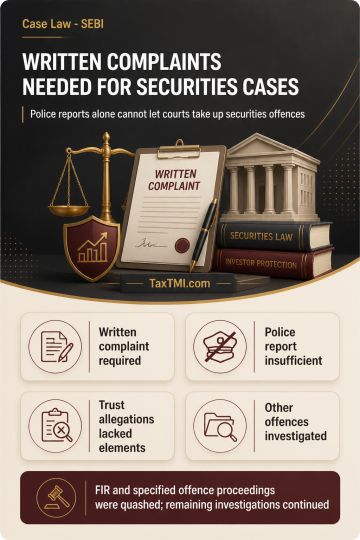
Written complaint requirement bars cognizance on police reports for securities offences, while unsupported breach of trust and cheating allegations fa...
Page of 4801
Press 'Enter' after typing page number.
341 to 360 of 96001 Results
❮
❯
❯❯
0 / 200
Expand Note
Add to Folder
No Folders have been created
+
Are you sure you want to delete "My most important" ?
The High Court held that GST Authorities cannot launch prosecution invoking penal provisions under the Indian Penal Code without invoking penal provisions of the GST Act, when the alleged offenses are covered under the GST Act provisions. This is especially true without obtaining sanction u/s 132(6) of the GST Act. The GST Act is a special legislation comprehensively dealing with GST-related procedures, penalties, and offenses. Allowing GST Authorities to bypass the prescribed procedure under the GST Act by simply invoking IPC provisions, without invoking GST Act penal provisions, especially when allegations constitute offenses covered under the GST Act, would amount to circumventing procedural safeguards like obtaining the Commissioner's sanction before initiating prosecution u/s 132(6). Such a course of action would be an abuse of the legal process, which cannot be permitted. Consequently, the prosecution launched without following the due process under the GST Act is hit by the legal bar and warrants quashment.
The High Court held that GST Authorities cannot launch prosecution invoking penal provisions under the Indian Penal Code without invoking penal provisions of the GST Act, when the alleged offenses are covered under the GST Act provisions. This is especially true without obtaining sanction u/s 132(6) of the GST Act. The GST Act is a special legislation comprehensively dealing with GST-related procedures, penalties, and offenses. Allowing GST Authorities to bypass the prescribed procedure under the GST Act by simply invoking IPC provisions, without invoking GST Act penal provisions, especially when allegations constitute offenses covered under the GST Act, would amount to circumventing procedural safeguards like obtaining the Commissioner's sanction before initiating prosecution u/s 132(6). Such a course of action would be an abuse of the legal process, which cannot be permitted. Consequently, the prosecution launched without following the due process under the GST Act is hit by the legal bar and warrants quashment.
Note: It is a system-generated summary and is for quick reference only.
 TaxTMI
 of 4801









 Join Channel


 TaxTMI