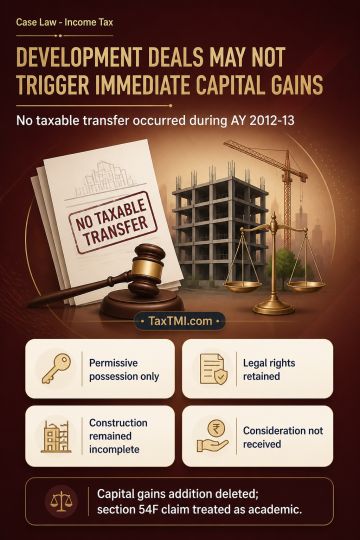
Development agreements require legal possession or effective enjoyment for capital gains transfer; permissive possession and deferred consideration de...
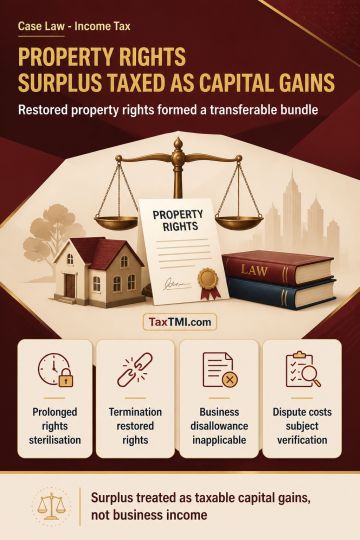
Prolonged sterilisation of development rights supports capital-gains treatment, while business-income disallowances cannot govern capital-gains comput...
Additional evidence in transfer pricing dispute leads to fresh examination, while tax deductions, TDS credit, fee and refund interest require verifica...
Category II AIF pass-through taxation preserves non-business income character; investment receipts cannot be reclassified without applying recognised ...
Rejected damaged paddy is classified under HSN 1006 10 90, not 1006 10 10, as it lacks characteristics of seed quality cereal crop and is unfit for human consumption. The exemption under S.No.70 of N/N. 02/2017-Central Tax (Rate) for rice (other than pre-packaged and labelled) is inapplicable as rejected damaged paddy has lost its food quality and human consumption value, being used for industrial usage or cattle feed. It fails to meet the criteria of being fit for human consumption required for the exemption. Therefore, rejected damaged paddy is taxable and does not qualify for the exemption.
Rejected damaged paddy is classified under HSN 1006 10 90, not 1006 10 10, as it lacks characteristics of seed quality cereal crop and is unfit for human consumption. The exemption under S.No.70 of N/N. 02/2017-Central Tax (Rate) for rice (other than pre-packaged and labelled) is inapplicable as rejected damaged paddy has lost its food quality and human consumption value, being used for industrial usage or cattle feed. It fails to meet the criteria of being fit for human consumption required for the exemption. Therefore, rejected damaged paddy is taxable and does not qualify for the exemption.
Note: It is a system-generated summary and is for quick reference only.
 TaxTMI
  TaxTMI
 of 4807









 Join Channel


