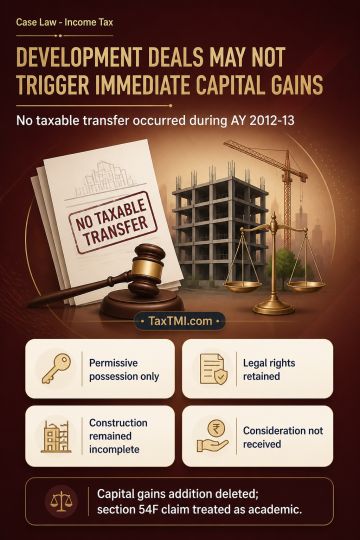
Development agreements require legal possession or effective enjoyment for capital gains transfer; permissive possession and deferred consideration de...
Prolonged sterilisation of development rights supports capital-gains treatment, while business-income disallowances cannot govern capital-gains comput...
Additional evidence in transfer pricing dispute leads to fresh examination, while tax deductions, TDS credit, fee and refund interest require verifica...
Category II AIF pass-through taxation preserves non-business income character; investment receipts cannot be reclassified without applying recognised ...
Determination of whether an outward supply of goods procured by the applicant from an Indian company undergoing liquidation can be considered a zero-rated supply under GST, allowing export without payment of tax against a Letter of Undertaking (LUT). The key points are: The place of supply is within India as the goods are delivered to the applicant's premises in India. The applicant lacks GST registration in India, and the transaction does not qualify as an export of goods under GST law. Consequently, the transaction cannot be treated as a zero-rated supply under the GST Act, 2017, precluding the applicant from exporting the goods without paying tax against an LUT.
Determination of whether an outward supply of goods procured by the applicant from an Indian company undergoing liquidation can be considered a zero-rated supply under GST, allowing export without payment of tax against a Letter of Undertaking (LUT). The key points are: The place of supply is within India as the goods are delivered to the applicant's premises in India. The applicant lacks GST registration in India, and the transaction does not qualify as an export of goods under GST law. Consequently, the transaction cannot be treated as a zero-rated supply under the GST Act, 2017, precluding the applicant from exporting the goods without paying tax against an LUT.
Note: It is a system-generated summary and is for quick reference only.
 TaxTMI
 of 4805










 Join Channel


 TaxTMI
