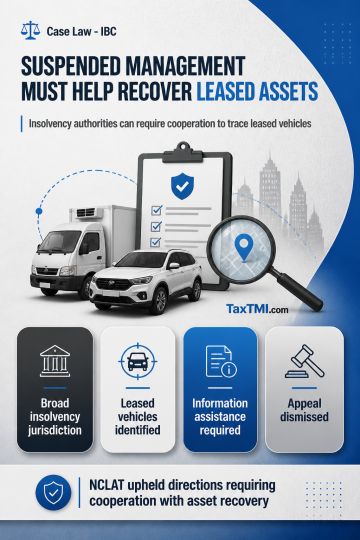
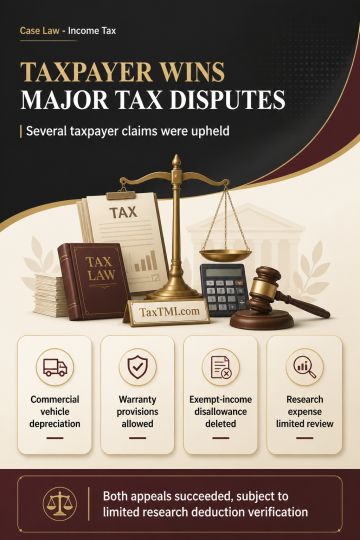
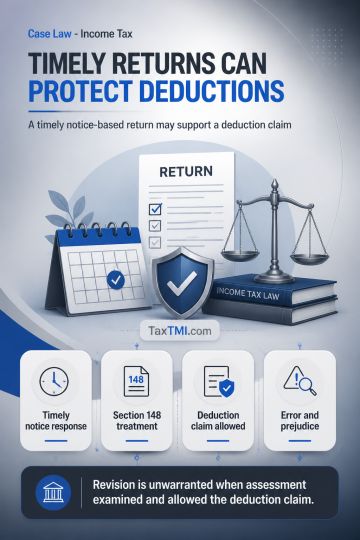
Commercial vehicle depreciation, scientifically determined warranty provisions and exempt-income disallowances were resolved in favour of the taxpayer...
Inherited property sale proceeds require capital-gains treatment where ownership is supported by evidence, not suspicion or unverified signature doubt...
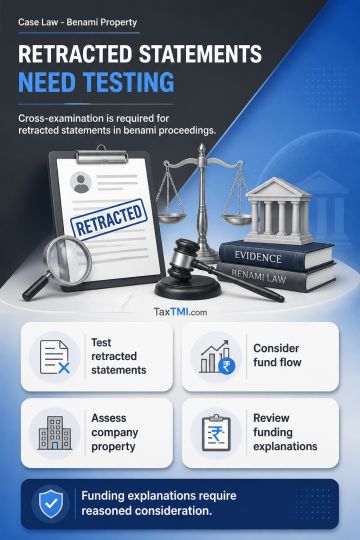
Cross-examination of retracted statements is essential where foundational evidence supports a benami allegation and documented funding explanations re...
Capital-goods exemption covers plant-modernisation accessories, while the import restriction applies only to earlier capital-goods components and spar...
Determination of whether an outward supply of goods procured by the applicant from an Indian company undergoing liquidation can be considered a zero-rated supply under GST, allowing export without payment of tax against a Letter of Undertaking (LUT). The key points are: The place of supply is within India as the goods are delivered to the applicant's premises in India. The applicant lacks GST registration in India, and the transaction does not qualify as an export of goods under GST law. Consequently, the transaction cannot be treated as a zero-rated supply under the GST Act, 2017, precluding the applicant from exporting the goods without paying tax against an LUT.
Determination of whether an outward supply of goods procured by the applicant from an Indian company undergoing liquidation can be considered a zero-rated supply under GST, allowing export without payment of tax against a Letter of Undertaking (LUT). The key points are: The place of supply is within India as the goods are delivered to the applicant's premises in India. The applicant lacks GST registration in India, and the transaction does not qualify as an export of goods under GST law. Consequently, the transaction cannot be treated as a zero-rated supply under the GST Act, 2017, precluding the applicant from exporting the goods without paying tax against an LUT.
Note: It is a system-generated summary and is for quick reference only.
 TaxTMI
 of 4801








 Join Channel


 TaxTMI