TNMM functional comparability requires excluding rice manufacturers from a pure Basmati rice trader's benchmark and recognising operating export recei...
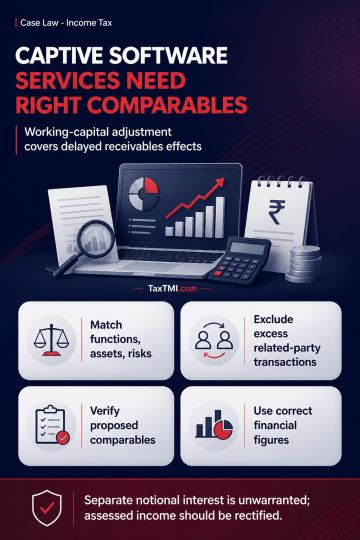
Working-capital adjustment subsumes delayed-receivable effects in TNMM benchmarking of captive software-development services, avoiding separate notion...
Transfer-pricing comparability requires exclusion of financially illogical super-profit comparables and correction of unsupported annual-report and ma...
Charitable character assessment preserves Section 80G approval despite inclusive spiritual teachings and incidental religious expenditure within the s...
Penalty proceedings for cash-loan acceptance require assessment proceedings and recorded Assessing Officer satisfaction; absent these, the proceedings...
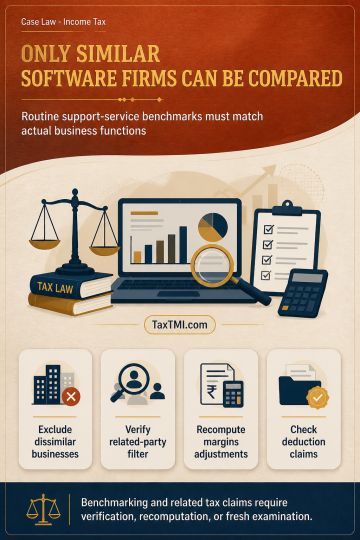
Functional comparability governs software-service benchmarking: dissimilar companies are excluded, while related-party filters, margins and working-ca...
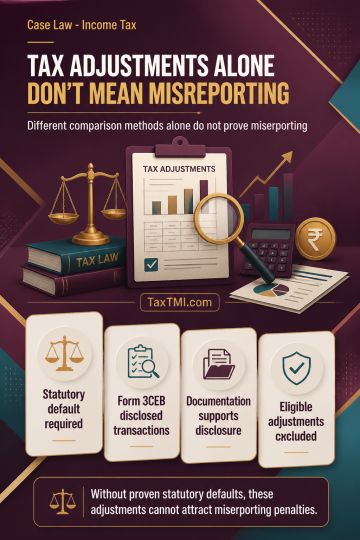
The Income Tax Appellate Tribunal (ITAT) held that no penalty u/s 271(1)(c) can be imposed for an ad-hoc disallowance of 20% of expenses made by the Assessing Officer. The ITAT relied on the Supreme Court's decision in CIT vs. Reliance Petro Products (P) Ltd., which stated that merely making an unsustainable claim, without any inaccuracy in furnishing particulars of income, does not attract penalty. The ITAT cited various High Court decisions, including CIT vs. Ajaib Singh and Co., Naranbhai Veerabhai and Co., and Addl. CIT vs. Delhi Cloth and General Mills Co. Ltd., which held that no concealment penalty can be imposed for disallowance of expenses on an estimated basis. Since the major amount was already deleted by the CIT(A)/NFAC, and the only addition was an estimated lump sum addition debited in the Profit and Loss Account, the ITAT opined that penalty u/s 271(1)(c) was not leviable. Consequently, the ITAT set aside the CIT(A)/NFAC's order and directed the Assessing Officer to delete the penalty levied u/s 271(1)(c), allowing the assessee's appeal.
The Income Tax Appellate Tribunal (ITAT) held that no penalty u/s 271(1)(c) can be imposed for an ad-hoc disallowance of 20% of expenses made by the Assessing Officer. The ITAT relied on the Supreme Court's decision in CIT vs. Reliance Petro Products (P) Ltd., which stated that merely making an unsustainable claim, without any inaccuracy in furnishing particulars of income, does not attract penalty. The ITAT cited various High Court decisions, including CIT vs. Ajaib Singh and Co., Naranbhai Veerabhai and Co., and Addl. CIT vs. Delhi Cloth and General Mills Co. Ltd., which held that no concealment penalty can be imposed for disallowance of expenses on an estimated basis. Since the major amount was already deleted by the CIT(A)/NFAC, and the only addition was an estimated lump sum addition debited in the Profit and Loss Account, the ITAT opined that penalty u/s 271(1)(c) was not leviable. Consequently, the ITAT set aside the CIT(A)/NFAC's order and directed the Assessing Officer to delete the penalty levied u/s 271(1)(c), allowing the assessee's appeal.
Note: It is a system-generated summary and is for quick reference only.
 TaxTMI
  TaxTMI
 of 4830
















 Join Channel


