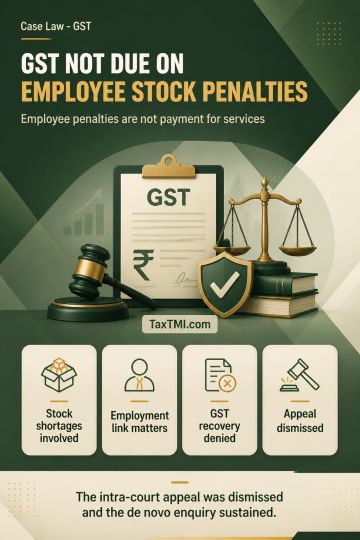
Employee stock-shortage penalties do not constitute consideration for services, preventing GST collection under Schedule II in employment relationship...
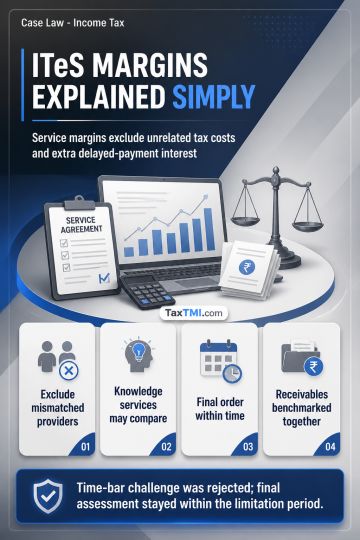
Transfer-pricing treatment of ITeS margins excludes pass-through tax recoveries and separate delayed-receivables interest after working-capital adjust...
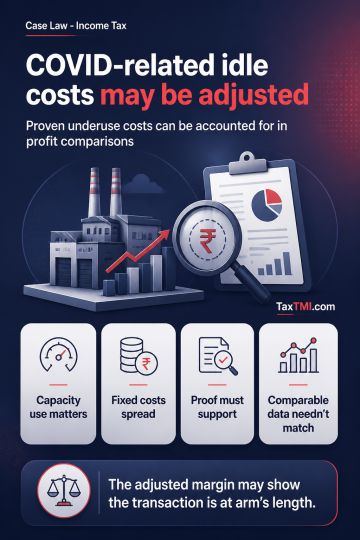
Capacity-utilisation adjustments under TNMM can neutralise substantiated COVID-related idle costs where underutilisation materially affects profitabil...
Page of 4830
Press 'Enter' after typing page number.
181 to 200 of 96587 Results
❮
❯
❯❯
0 / 200
Expand Note
Add to Folder
No Folders have been created
+
Are you sure you want to delete "My most important" ?
The Income Tax Appellate Tribunal (ITAT) held that no penalty u/s 271(1)(c) can be imposed for an ad-hoc disallowance of 20% of expenses made by the Assessing Officer. The ITAT relied on the Supreme Court's decision in CIT vs. Reliance Petro Products (P) Ltd., which stated that merely making an unsustainable claim, without any inaccuracy in furnishing particulars of income, does not attract penalty. The ITAT cited various High Court decisions, including CIT vs. Ajaib Singh and Co., Naranbhai Veerabhai and Co., and Addl. CIT vs. Delhi Cloth and General Mills Co. Ltd., which held that no concealment penalty can be imposed for disallowance of expenses on an estimated basis. Since the major amount was already deleted by the CIT(A)/NFAC, and the only addition was an estimated lump sum addition debited in the Profit and Loss Account, the ITAT opined that penalty u/s 271(1)(c) was not leviable. Consequently, the ITAT set aside the CIT(A)/NFAC's order and directed the Assessing Officer to delete the penalty levied u/s 271(1)(c), allowing the assessee's appeal.
The Income Tax Appellate Tribunal (ITAT) held that no penalty u/s 271(1)(c) can be imposed for an ad-hoc disallowance of 20% of expenses made by the Assessing Officer. The ITAT relied on the Supreme Court's decision in CIT vs. Reliance Petro Products (P) Ltd., which stated that merely making an unsustainable claim, without any inaccuracy in furnishing particulars of income, does not attract penalty. The ITAT cited various High Court decisions, including CIT vs. Ajaib Singh and Co., Naranbhai Veerabhai and Co., and Addl. CIT vs. Delhi Cloth and General Mills Co. Ltd., which held that no concealment penalty can be imposed for disallowance of expenses on an estimated basis. Since the major amount was already deleted by the CIT(A)/NFAC, and the only addition was an estimated lump sum addition debited in the Profit and Loss Account, the ITAT opined that penalty u/s 271(1)(c) was not leviable. Consequently, the ITAT set aside the CIT(A)/NFAC's order and directed the Assessing Officer to delete the penalty levied u/s 271(1)(c), allowing the assessee's appeal.
Note: It is a system-generated summary and is for quick reference only.
 TaxTMI
  TaxTMI
 of 4830








 Join Channel


