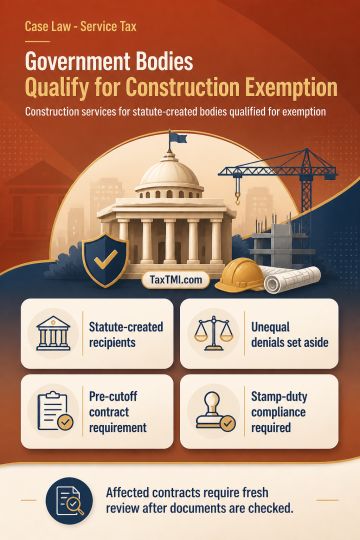
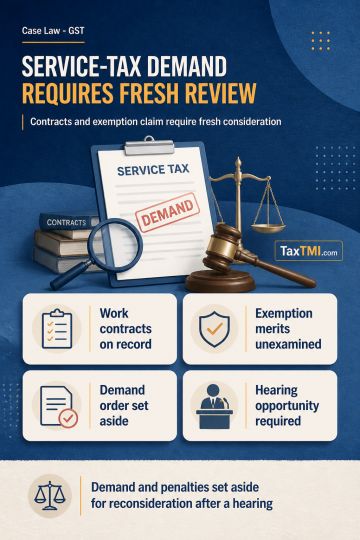
Governmental authority status supports construction-service exemption, while pre-cutoff contract and stamp-duty compliance requires verification on re...
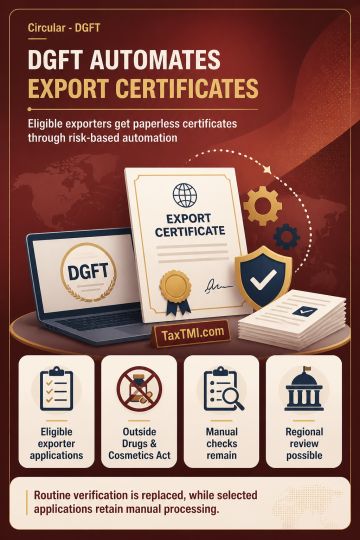
Automated Free Sale and Commerce Certificates enable paperless processing while retaining risk-based manual verification for selected exporter applica...
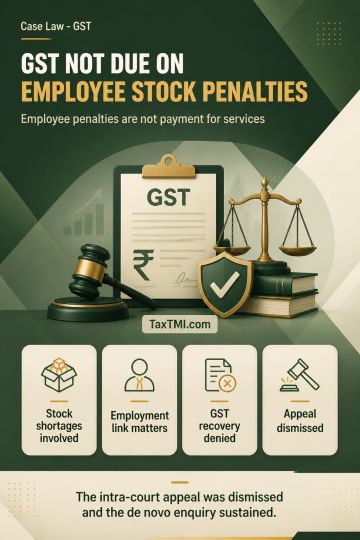
Employee stock-shortage penalties do not constitute consideration for services, preventing GST collection under Schedule II in employment relationship...
The appellant sought refund of Countervailing Duty (CVD) and Special Additional Duty (SAD) paid in cash u/s 11B of the Central Excise Act, 1944 read with Section 142(3) and 142(6)(A) of the Central Goods and Service Tax Act, 2017. They argued that since they paid the duty after GST introduction and were eligible for credit of CVD and SAD, they were entitled to refund. The Tribunal held that Section 142 allows refund in cash only when refunds are admissible under existing law but cannot be refunded in credit. The existing law, i.e., Central Excise Act and Rules, provides for cash refund of credit taken by the assessee under limited provisions like Rules 5, 5A, and 5B of the Cenvat Credit Rules 2004, which do not cover the appellant's case. Therefore, Section 142 does not entitle them to cash refund. Further, Section 142(6) covers refund in cash when refund or credit admissibility is in dispute before judicial forums, which is not the case here. The refund in cash u/s 142(3) is admissible only if refund is otherwise admissible in cash under existing law, which is not the case. Hence, the appeal was dismissed.
The appellant sought refund of Countervailing Duty (CVD) and Special Additional Duty (SAD) paid in cash u/s 11B of the Central Excise Act, 1944 read with Section 142(3) and 142(6)(A) of the Central Goods and Service Tax Act, 2017. They argued that since they paid the duty after GST introduction and were eligible for credit of CVD and SAD, they were entitled to refund. The Tribunal held that Section 142 allows refund in cash only when refunds are admissible under existing law but cannot be refunded in credit. The existing law, i.e., Central Excise Act and Rules, provides for cash refund of credit taken by the assessee under limited provisions like Rules 5, 5A, and 5B of the Cenvat Credit Rules 2004, which do not cover the appellant's case. Therefore, Section 142 does not entitle them to cash refund. Further, Section 142(6) covers refund in cash when refund or credit admissibility is in dispute before judicial forums, which is not the case here. The refund in cash u/s 142(3) is admissible only if refund is otherwise admissible in cash under existing law, which is not the case. Hence, the appeal was dismissed.
Note: It is a system-generated summary and is for quick reference only.
 TaxTMI
  TaxTMI
 of 4828



 Join Channel


