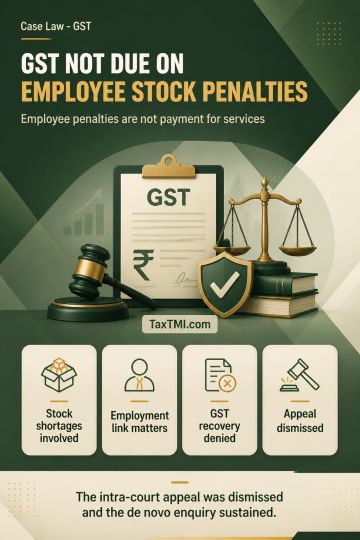
Employee stock-shortage penalties do not constitute consideration for services, preventing GST collection under Schedule II in employment relationship...
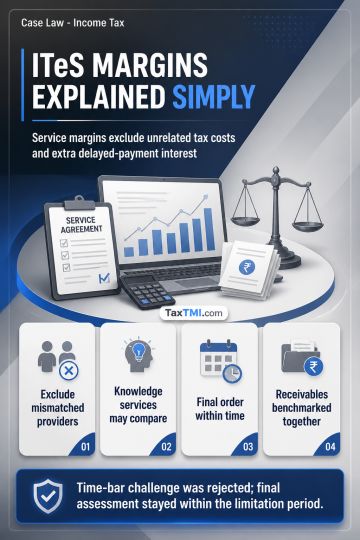
Transfer-pricing treatment of ITeS margins excludes pass-through tax recoveries and separate delayed-receivables interest after working-capital adjust...
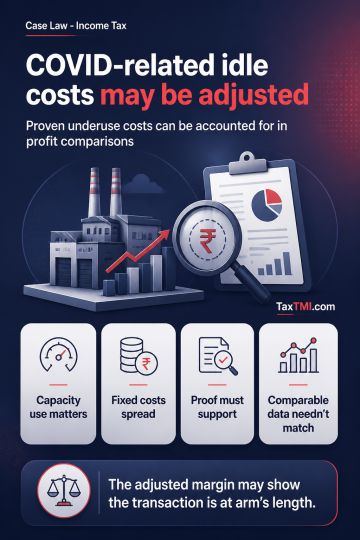
Capacity-utilisation adjustments under TNMM can neutralise substantiated COVID-related idle costs where underutilisation materially affects profitabil...
Page of 4830
Press 'Enter' after typing page number.
181 to 200 of 96587 Results
❮
❯
❯❯
0 / 200
Expand Note
Add to Folder
No Folders have been created
+
Are you sure you want to delete "My most important" ?
The case pertains to the disallowance of a provision for contract losses by the CIT(A) and AO, who erroneously concluded it as an unascertained liability not deductible u/s 37. The provision represents the excess of estimated contract expenditure over estimated contract revenues. The ITAT held that the provision constitutes an ascertained liability/probable loss for the assessee, made on a scientific basis. Both lower authorities erred in appreciating that revenue from the contract was also recognized on a percentage of completion basis. The case laws cited by the assessee support this view. The FLSmidth case is distinguishable as the assessee couldn't explain how contract costs would exceed revenues. However, in the present case, the assessee recognized revenue and expenses on the same methodology, supported by computations, and the provision was reversed in subsequent years. The Triveni Engg case is on similar facts, where the court allowed the deduction for such a provision. Therefore, the impugned provision is an allowable deduction, and the question of adding it to book profits does not arise. The assessee's appeal is allowed.
The case pertains to the disallowance of a provision for contract losses by the CIT(A) and AO, who erroneously concluded it as an unascertained liability not deductible u/s 37. The provision represents the excess of estimated contract expenditure over estimated contract revenues. The ITAT held that the provision constitutes an ascertained liability/probable loss for the assessee, made on a scientific basis. Both lower authorities erred in appreciating that revenue from the contract was also recognized on a percentage of completion basis. The case laws cited by the assessee support this view. The FLSmidth case is distinguishable as the assessee couldn't explain how contract costs would exceed revenues. However, in the present case, the assessee recognized revenue and expenses on the same methodology, supported by computations, and the provision was reversed in subsequent years. The Triveni Engg case is on similar facts, where the court allowed the deduction for such a provision. Therefore, the impugned provision is an allowable deduction, and the question of adding it to book profits does not arise. The assessee's appeal is allowed.
Note: It is a system-generated summary and is for quick reference only.
 TaxTMI
  TaxTMI
 of 4830



 Join Channel


