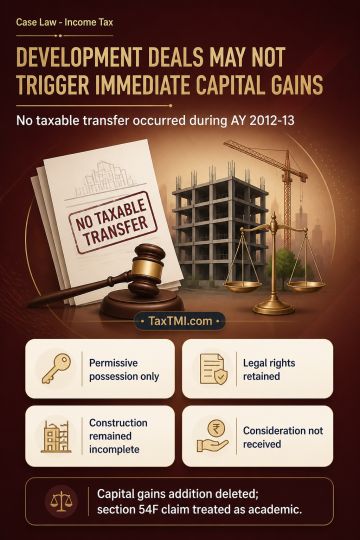
Development agreements require legal possession or effective enjoyment for capital gains transfer; permissive possession and deferred consideration de...
Prolonged sterilisation of development rights supports capital-gains treatment, while business-income disallowances cannot govern capital-gains comput...
Additional evidence in transfer pricing dispute leads to fresh examination, while tax deductions, TDS credit, fee and refund interest require verifica...
Category II AIF pass-through taxation preserves non-business income character; investment receipts cannot be reclassified without applying recognised ...
Mutual fund maturity rules require proper rollover, redemption, disclosure, and due diligence; investor gains cannot excuse regulatory breaches or pen...
The High Court set aside the order cancelling the petitioner's registration under the Central Goods and Services Tax Act, 2017 and the West Bengal Goods and Services Tax Act, 2017, subject to the condition that the petitioner files returns for the entire period of default and pays the requisite amount of tax, interest, fine, and penalty, if not already paid. The cancellation was due to the petitioner's failure to comply with statutory provisions by not filing returns, but the Court noted that suspension/revocation would be counterproductive and against revenue interests as it would prevent the petitioner from carrying on business and raising invoices, ultimately impacting tax recovery. The Court took a pragmatic view, considering that the respondents did not allege dubious processes to evade tax.
The High Court set aside the order cancelling the petitioner's registration under the Central Goods and Services Tax Act, 2017 and the West Bengal Goods and Services Tax Act, 2017, subject to the condition that the petitioner files returns for the entire period of default and pays the requisite amount of tax, interest, fine, and penalty, if not already paid. The cancellation was due to the petitioner's failure to comply with statutory provisions by not filing returns, but the Court noted that suspension/revocation would be counterproductive and against revenue interests as it would prevent the petitioner from carrying on business and raising invoices, ultimately impacting tax recovery. The Court took a pragmatic view, considering that the respondents did not allege dubious processes to evade tax.
Note: It is a system-generated summary and is for quick reference only.
 TaxTMI
 of 4807

















 Join Channel


 TaxTMI