Commercial vehicle depreciation, scientifically determined warranty provisions and exempt-income disallowances were resolved in favour of the taxpayer...
Inherited property sale proceeds require capital-gains treatment where ownership is supported by evidence, not suspicion or unverified signature doubt...
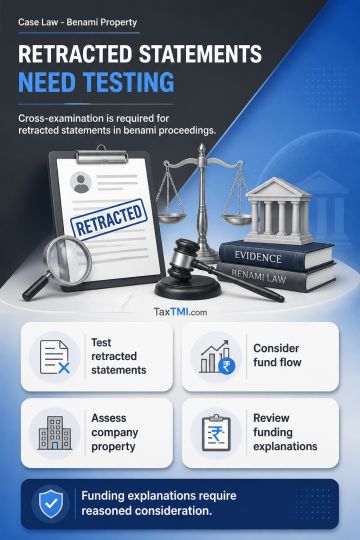
Cross-examination of retracted statements is essential where foundational evidence supports a benami allegation and documented funding explanations re...
Capital-goods exemption covers plant-modernisation accessories, while the import restriction applies only to earlier capital-goods components and spar...
Constitutional judicial review permits challenges to ECIRs and connected money-laundering proceedings where coercive action affects fundamental intere...
Page of 4800
Press 'Enter' after typing page number.
421 to 440 of 95999 Results
❮
❯
❯❯
0 / 200
Expand Note
Add to Folder
No Folders have been created
+
Are you sure you want to delete "My most important" ?
A review application is maintainable on (i) discovery of new and important evidence which could not be produced earlier despite due diligence, (ii) mistake or error apparent on the face of record, or (iii) any other sufficient reason. The Supreme Court held that review cannot be done unless a material error manifestly apparent on the face of the order would result in miscarriage of justice. Review proceedings are strictly confined to the ambit of Order 47 Rule 1 CPC. A party cannot repeat old arguments under the guise of a review petition. The power of review is distinct from appellate power to correct errors. In the present case, the HC found no error apparent on the record to warrant interference with its earlier order holding that the respondent is entitled to receive original non-relied documents u/s 67(3) of CGST Act and Rule 27 of Central Excise Rules 2017. Consequently, the review petition was dismissed.
A review application is maintainable on (i) discovery of new and important evidence which could not be produced earlier despite due diligence, (ii) mistake or error apparent on the face of record, or (iii) any other sufficient reason. The Supreme Court held that review cannot be done unless a material error manifestly apparent on the face of the order would result in miscarriage of justice. Review proceedings are strictly confined to the ambit of Order 47 Rule 1 CPC. A party cannot repeat old arguments under the guise of a review petition. The power of review is distinct from appellate power to correct errors. In the present case, the HC found no error apparent on the record to warrant interference with its earlier order holding that the respondent is entitled to receive original non-relied documents u/s 67(3) of CGST Act and Rule 27 of Central Excise Rules 2017. Consequently, the review petition was dismissed.
Note: It is a system-generated summary and is for quick reference only.
 TaxTMI
 of 4800






















 Join Channel


 TaxTMI
