Governmental authority status supports construction-service exemption, while pre-cutoff contract and stamp-duty compliance requires verification on re...
Automated Free Sale and Commerce Certificates enable paperless processing while retaining risk-based manual verification for selected exporter applica...
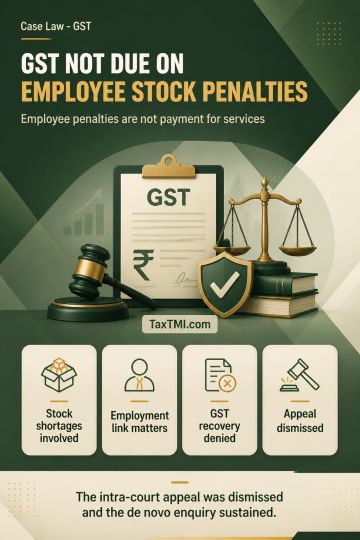
Employee stock-shortage penalties do not constitute consideration for services, preventing GST collection under Schedule II in employment relationship...
Penalty proceedings u/s 271(1)(c) involved an addition based on estimation by the Assessing Officer, which was later re-estimated by the CIT(A) to disallow 10% of the expenditure while adjudicating the quantum appeal. It was not disputed that the assessee had furnished details regarding expenditure and income in the return of income. The disallowance by the revenue was due to the fact that the claim was not acceptable to them. The Hon'ble Supreme Court in CIT v. UP State Bridge Corporation Ltd held that where the assessee had furnished certain details regarding expenditure and income in the return, which were not found inaccurate, nor could be viewed as concealment of income, merely because the claim was not accepted or was not acceptable by the revenue, that by itself would not attract penalty u/s 271(1)(c). The ITAT held that no penalty can be levied in a case where the disallowance of expenditure is estimated and was inclined to delete the penalty levied by the Assessing Officer, deciding in favor of the assessee.
Penalty proceedings u/s 271(1)(c) involved an addition based on estimation by the Assessing Officer, which was later re-estimated by the CIT(A) to disallow 10% of the expenditure while adjudicating the quantum appeal. It was not disputed that the assessee had furnished details regarding expenditure and income in the return of income. The disallowance by the revenue was due to the fact that the claim was not acceptable to them. The Hon'ble Supreme Court in CIT v. UP State Bridge Corporation Ltd held that where the assessee had furnished certain details regarding expenditure and income in the return, which were not found inaccurate, nor could be viewed as concealment of income, merely because the claim was not accepted or was not acceptable by the revenue, that by itself would not attract penalty u/s 271(1)(c). The ITAT held that no penalty can be levied in a case where the disallowance of expenditure is estimated and was inclined to delete the penalty levied by the Assessing Officer, deciding in favor of the assessee.
Note: It is a system-generated summary and is for quick reference only.
 TaxTMI
  TaxTMI
 of 4828











 Join Channel


