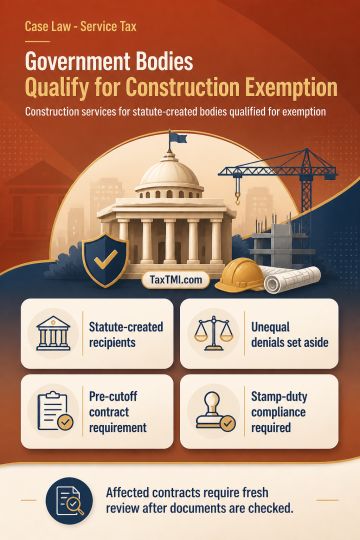
Governmental authority status supports construction-service exemption, while pre-cutoff contract and stamp-duty compliance requires verification on re...
Automated Free Sale and Commerce Certificates enable paperless processing while retaining risk-based manual verification for selected exporter applica...
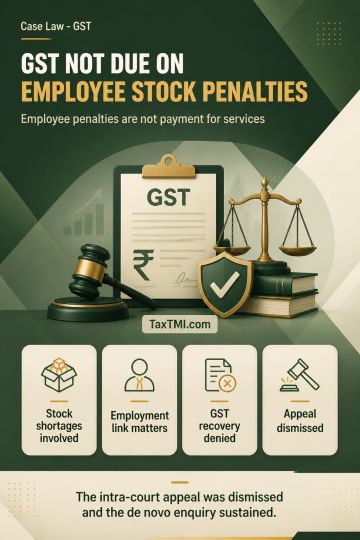
Employee stock-shortage penalties do not constitute consideration for services, preventing GST collection under Schedule II in employment relationship...
Key legal principles and decisions related to various disallowances and additions made by the Assessing Officer (AO) under different sections of the Income Tax Act. The critical points covered are: Cessation of liability u/s 41(1): The onus is on the AO to provide concrete evidence for cessation or remission of liability. Non-payment over time or time-barred debts do not automatically constitute cessation. Clear and specific evidence is required. Disallowance u/s 37(1): Disallowances should be made only when there is clear evidence that the expenditure is not for business purposes. Ad hoc disallowances without substantial evidence are arbitrary and unjustified. Assessee's documentation and audited financial statements demonstrating genuineness of expenses should be considered. Disallowance of personal expenses: Disallowances cannot be based on assumptions or lack of evidence of personal use. Assessee's demonstration of business purpose and tax auditor's acceptance should be considered. Interest disallowance u/s 36(1)(iii): The principle of fungibility of funds should be applied. If the assessee had sufficient interest-free funds to cover the loan, interest deduction should be allowed for loans advanced for commercial expediency. Disallowance u/s 14A read with Rule 8D.
Key legal principles and decisions related to various disallowances and additions made by the Assessing Officer (AO) under different sections of the Income Tax Act. The critical points covered are: Cessation of liability u/s 41(1): The onus is on the AO to provide concrete evidence for cessation or remission of liability. Non-payment over time or time-barred debts do not automatically constitute cessation. Clear and specific evidence is required. Disallowance u/s 37(1): Disallowances should be made only when there is clear evidence that the expenditure is not for business purposes. Ad hoc disallowances without substantial evidence are arbitrary and unjustified. Assessee's documentation and audited financial statements demonstrating genuineness of expenses should be considered. Disallowance of personal expenses: Disallowances cannot be based on assumptions or lack of evidence of personal use. Assessee's demonstration of business purpose and tax auditor's acceptance should be considered. Interest disallowance u/s 36(1)(iii): The principle of fungibility of funds should be applied. If the assessee had sufficient interest-free funds to cover the loan, interest deduction should be allowed for loans advanced for commercial expediency. Disallowance u/s 14A read with Rule 8D.
Note: It is a system-generated summary and is for quick reference only.
 TaxTMI
  TaxTMI
 of 4828









 Join Channel


