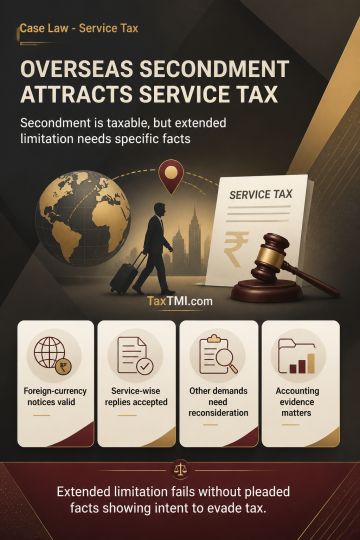
Extended limitation fails without specific suppression allegations, while overseas employee secondment remains taxable as manpower supply within norma...
Time-share accommodation classification excludes Club or Association Service where purchasers receive contractual occupancy rights without genuine mem...
CENVAT credit for trading requires reversal, while taxable-service rental credit remains proportionately available and limitation issues await resolut...
Vicarious liability for dishonoured company cheques may extend to non-signatory directors where complaints contain foundational responsibility avermen...
GST Authorities invoked penal provisions under Indian Penal Code against the petitioner without invoking penal provisions of GST Act, despite the alleged offences being covered under GST Act. This was done without obtaining sanction u/s 132(6) of GST Act. The court held that GST Act is a special legislation dealing with GST-related procedures, penalties, and offences. Authorities cannot bypass the prescribed procedure for launching prosecution under GST Act by simply invoking IPC provisions without invoking GST Act provisions, especially when allegations constitute offences covered under GST Act. Doing so would amount to bypassing procedural safeguards like obtaining commissioner's sanction u/s 132(6), prejudicing the petitioner. Allowing authorities to adopt such a course would be an abuse of process of law, which cannot be permitted. Consequently, the petition was allowed, quashing the prosecution launched without following due process under GST Act.
GST Authorities invoked penal provisions under Indian Penal Code against the petitioner without invoking penal provisions of GST Act, despite the alleged offences being covered under GST Act. This was done without obtaining sanction u/s 132(6) of GST Act. The court held that GST Act is a special legislation dealing with GST-related procedures, penalties, and offences. Authorities cannot bypass the prescribed procedure for launching prosecution under GST Act by simply invoking IPC provisions without invoking GST Act provisions, especially when allegations constitute offences covered under GST Act. Doing so would amount to bypassing procedural safeguards like obtaining commissioner's sanction u/s 132(6), prejudicing the petitioner. Allowing authorities to adopt such a course would be an abuse of process of law, which cannot be permitted. Consequently, the petition was allowed, quashing the prosecution launched without following due process under GST Act.
Note: It is a system-generated summary and is for quick reference only.
 TaxTMI
 of 4801










 Join Channel


 TaxTMI