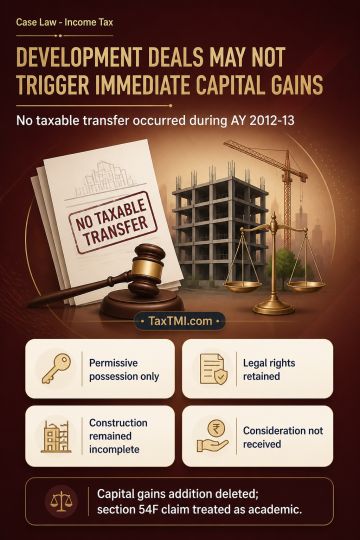
Development agreements require legal possession or effective enjoyment for capital gains transfer; permissive possession and deferred consideration de...
Prolonged sterilisation of development rights supports capital-gains treatment, while business-income disallowances cannot govern capital-gains comput...
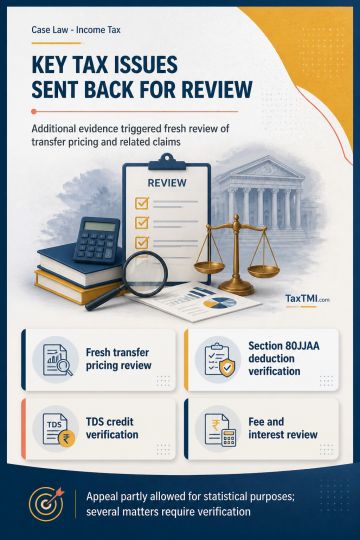
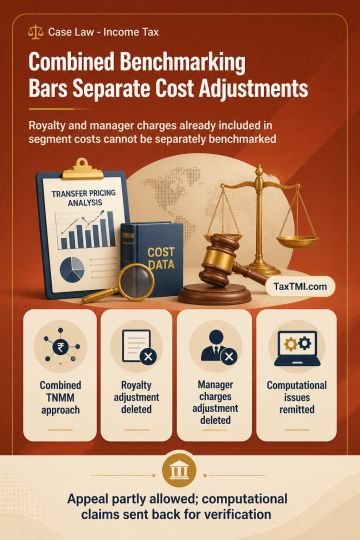
Additional evidence in transfer pricing dispute leads to fresh examination, while tax deductions, TDS credit, fee and refund interest require verifica...
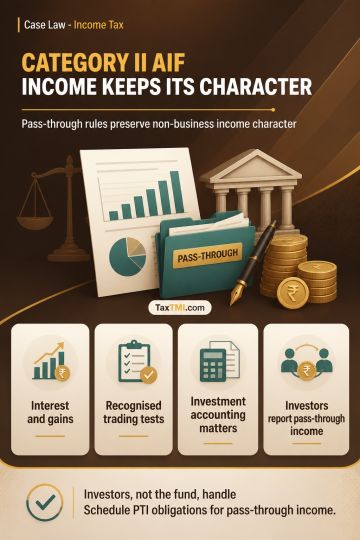
Category II AIF pass-through taxation preserves non-business income character; investment receipts cannot be reclassified without applying recognised ...
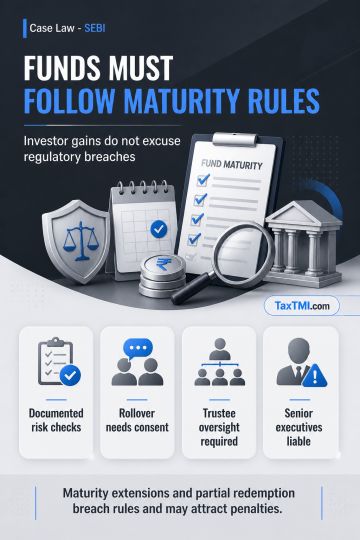
Mutual fund maturity rules require proper rollover, redemption, disclosure, and due diligence; investor gains cannot excuse regulatory breaches or pen...
Depreciation on glow sign boards and oxygen gas cylinders was rejected by the Assessing Officer, holding that the transaction on the last day of the accounting year cannot constitute business, and glow sign boards were advertising material, not plant. The ITAT held that sale proceeds of an asset on which deduction u/s 32(1)(ii) was claimed and allowed are required to be taxed as short-term capital gain u/s 50. The Supreme Court decision in Nectar Beverages case clarified that bottles and crates purchased before 31.03.1995 did not form part of the block of assets, and profits on their sale were not taxable as balancing charge u/s 41(1) or Section 50. However, for bottles and crates purchased after 01.04.1995, due to deletion of proviso to Section 31(1)(ii), such assets formed part of the block of assets and were exigible to capital gains tax u/s 50. The question of law was answered in favor of the assessee, holding that the Tribunal was incorrect in ruling that sale proceeds of an asset on which deduction u/s 32(1)(ii) was claimed and allowed are required to be taxed as short-term capital gain u/s 50.
Depreciation on glow sign boards and oxygen gas cylinders was rejected by the Assessing Officer, holding that the transaction on the last day of the accounting year cannot constitute business, and glow sign boards were advertising material, not plant. The ITAT held that sale proceeds of an asset on which deduction u/s 32(1)(ii) was claimed and allowed are required to be taxed as short-term capital gain u/s 50. The Supreme Court decision in Nectar Beverages case clarified that bottles and crates purchased before 31.03.1995 did not form part of the block of assets, and profits on their sale were not taxable as balancing charge u/s 41(1) or Section 50. However, for bottles and crates purchased after 01.04.1995, due to deletion of proviso to Section 31(1)(ii), such assets formed part of the block of assets and were exigible to capital gains tax u/s 50. The question of law was answered in favor of the assessee, holding that the Tribunal was incorrect in ruling that sale proceeds of an asset on which deduction u/s 32(1)(ii) was claimed and allowed are required to be taxed as short-term capital gain u/s 50.
Note: It is a system-generated summary and is for quick reference only.
 TaxTMI
 of 4794






 Join Channel


 TaxTMI
