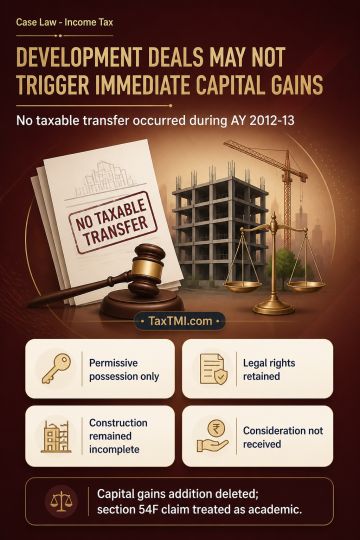
Development agreements require legal possession or effective enjoyment for capital gains transfer; permissive possession and deferred consideration de...
Prolonged sterilisation of development rights supports capital-gains treatment, while business-income disallowances cannot govern capital-gains comput...
Additional evidence in transfer pricing dispute leads to fresh examination, while tax deductions, TDS credit, fee and refund interest require verifica...
Category II AIF pass-through taxation preserves non-business income character; investment receipts cannot be reclassified without applying recognised ...
The case pertains to the alleged misdeclaration of value of zinc ash, a restricted item under the Foreign Trade Policy, requiring an import license. The goods were classified as hazardous waste and subject to re-export u/r 17(2) of the Hazardous Waste Rules, 2008. The authorities imposed a fine u/s 125 of the Customs Act, 1962, in lieu of confiscation u/ss 111(d) and 111(m), and a penalty u/s 112. The Tribunal held that invoking Section 111(m) for enhanced value due to non-compliance with the Customs Valuation Rules was not justified. The misdescription did not warrant Section 111(m) as the goods had not cleared for home consumption, and no conspiracy was established. Re-export was ordered under the Hazardous Waste Rules, not as an alternative clearance option under the Customs Act. Citing a precedent, the Tribunal stated that importers have a statutory right to re-export prohibited goods, which cannot be overlooked by authorities. The issue of undervaluation arises after determining the goods' prohibited status. Consequently, the redemption fine u/s 125 and penalty u/s 112 were set aside, and the appeal was allowed.
The case pertains to the alleged misdeclaration of value of zinc ash, a restricted item under the Foreign Trade Policy, requiring an import license. The goods were classified as hazardous waste and subject to re-export u/r 17(2) of the Hazardous Waste Rules, 2008. The authorities imposed a fine u/s 125 of the Customs Act, 1962, in lieu of confiscation u/ss 111(d) and 111(m), and a penalty u/s 112. The Tribunal held that invoking Section 111(m) for enhanced value due to non-compliance with the Customs Valuation Rules was not justified. The misdescription did not warrant Section 111(m) as the goods had not cleared for home consumption, and no conspiracy was established. Re-export was ordered under the Hazardous Waste Rules, not as an alternative clearance option under the Customs Act. Citing a precedent, the Tribunal stated that importers have a statutory right to re-export prohibited goods, which cannot be overlooked by authorities. The issue of undervaluation arises after determining the goods' prohibited status. Consequently, the redemption fine u/s 125 and penalty u/s 112 were set aside, and the appeal was allowed.
Note: It is a system-generated summary and is for quick reference only.
 TaxTMI
 of 4801














 Join Channel


 TaxTMI

