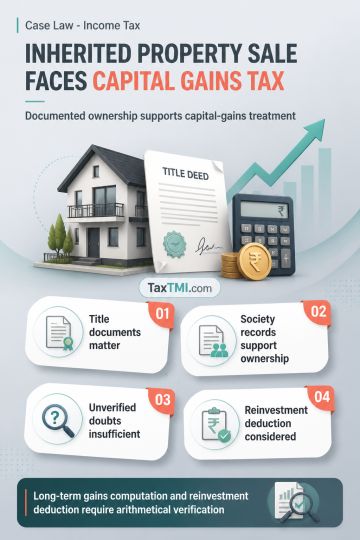
Inherited property sale proceeds require capital-gains treatment where ownership is supported by evidence, not suspicion or unverified signature doubt...
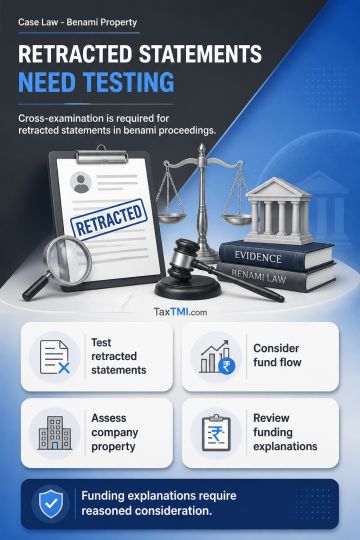
Cross-examination of retracted statements is essential where foundational evidence supports a benami allegation and documented funding explanations re...
Capital-goods exemption covers plant-modernisation accessories, while the import restriction applies only to earlier capital-goods components and spar...
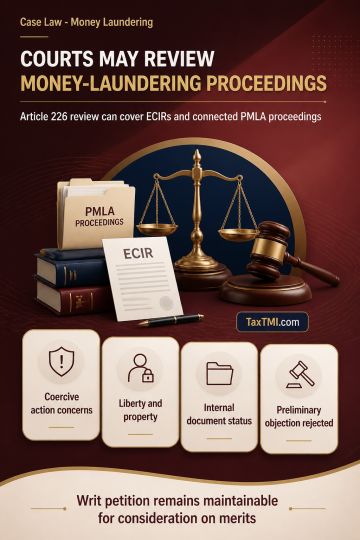
Constitutional judicial review permits challenges to ECIRs and connected money-laundering proceedings where coercive action affects fundamental intere...
The appellant wrongly availed Cenvat credit on input services for unsold flats after issuance of completion certificate, contravening Rules 6(3) and 6(3A) of the Cenvat Credit Rules, 2004. Section 73(2) of the Finance Act, 1994, read with Rule 14 of the Cenvat Credit Rules, 2004, was invoked for extended period of limitation, interest, and penalty. The appellant admitted that after receiving the completion certificate, the building became immovable property, and booking receipts were for sale of property, not service. The appellant had the option to take proportionate credit for sold flats and reverse the balance for unsold flats. Cenvat credit eligibility has a direct nexus with tax payment liability. Since the appellant had no service tax liability for unsold flats, they were ineligible to retain the availed Cenvat credit. The Tribunal affirmed the invocation of extended period, penalty, and interest, as the appellant suppressed material facts with intent to evade service tax liability. The appeal was dismissed.
The appellant wrongly availed Cenvat credit on input services for unsold flats after issuance of completion certificate, contravening Rules 6(3) and 6(3A) of the Cenvat Credit Rules, 2004. Section 73(2) of the Finance Act, 1994, read with Rule 14 of the Cenvat Credit Rules, 2004, was invoked for extended period of limitation, interest, and penalty. The appellant admitted that after receiving the completion certificate, the building became immovable property, and booking receipts were for sale of property, not service. The appellant had the option to take proportionate credit for sold flats and reverse the balance for unsold flats. Cenvat credit eligibility has a direct nexus with tax payment liability. Since the appellant had no service tax liability for unsold flats, they were ineligible to retain the availed Cenvat credit. The Tribunal affirmed the invocation of extended period, penalty, and interest, as the appellant suppressed material facts with intent to evade service tax liability. The appeal was dismissed.
Note: It is a system-generated summary and is for quick reference only.
 TaxTMI
 of 4786






 Join Channel


 TaxTMI