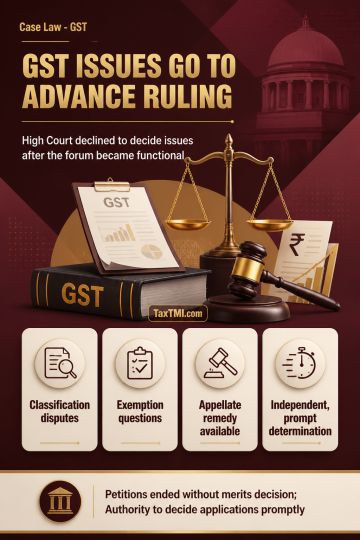
Advance-ruling mechanism governs pending GST classification, exemption and taxability disputes, limiting writ review once the specialised forum functi...
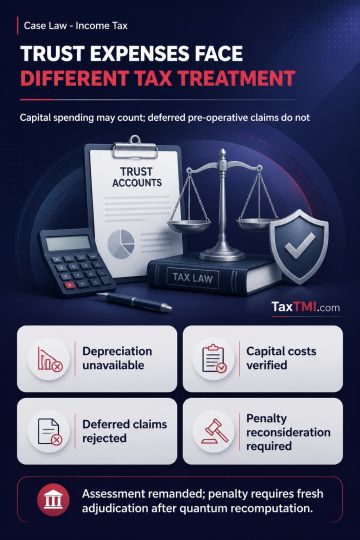
Charitable trust income application permits verified capital expenditure but rejects deferred pre-operative claims and requires reconsideration of con...
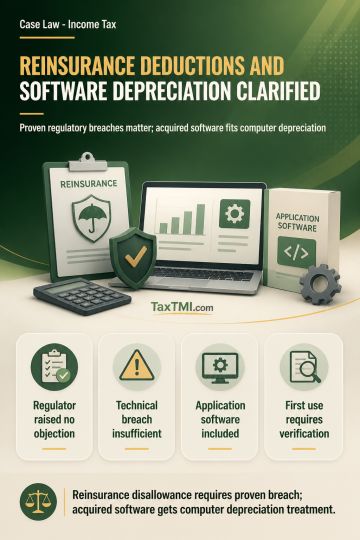
Reinsurance premium deductions require established regulatory breaches, while independently acquired software qualifies within the computer depreciati...
Page of 4796
Press 'Enter' after typing page number.
761 to 780 of 95918 Results
❮
❯
❯❯
0 / 200
Expand Note
Add to Folder
No Folders have been created
+
Are you sure you want to delete "My most important" ?
The appellant wrongly availed Cenvat credit on input services for unsold flats after issuance of completion certificate, contravening Rules 6(3) and 6(3A) of the Cenvat Credit Rules, 2004. Section 73(2) of the Finance Act, 1994, read with Rule 14 of the Cenvat Credit Rules, 2004, was invoked for extended period of limitation, interest, and penalty. The appellant admitted that after receiving the completion certificate, the building became immovable property, and booking receipts were for sale of property, not service. The appellant had the option to take proportionate credit for sold flats and reverse the balance for unsold flats. Cenvat credit eligibility has a direct nexus with tax payment liability. Since the appellant had no service tax liability for unsold flats, they were ineligible to retain the availed Cenvat credit. The Tribunal affirmed the invocation of extended period, penalty, and interest, as the appellant suppressed material facts with intent to evade service tax liability. The appeal was dismissed.
The appellant wrongly availed Cenvat credit on input services for unsold flats after issuance of completion certificate, contravening Rules 6(3) and 6(3A) of the Cenvat Credit Rules, 2004. Section 73(2) of the Finance Act, 1994, read with Rule 14 of the Cenvat Credit Rules, 2004, was invoked for extended period of limitation, interest, and penalty. The appellant admitted that after receiving the completion certificate, the building became immovable property, and booking receipts were for sale of property, not service. The appellant had the option to take proportionate credit for sold flats and reverse the balance for unsold flats. Cenvat credit eligibility has a direct nexus with tax payment liability. Since the appellant had no service tax liability for unsold flats, they were ineligible to retain the availed Cenvat credit. The Tribunal affirmed the invocation of extended period, penalty, and interest, as the appellant suppressed material facts with intent to evade service tax liability. The appeal was dismissed.
Note: It is a system-generated summary and is for quick reference only.
 TaxTMI
 of 4796



 Join Channel


 TaxTMI