Online bond platforms may offer overseas-regulated products and tax-specific bonds subject to disclosures, compliance safeguards and revised complianc...
Corporate guarantee valuation permits actual ascertainable commission while barring retroactive application and extended-period penalties for bona fid...
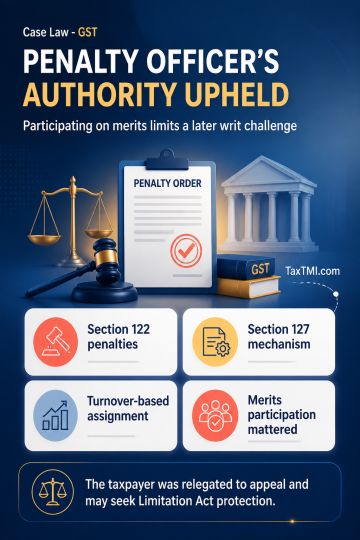
Proper-officer jurisdiction under UPGST penalty provisions upheld; participation on merits prevents bypassing the statutory appellate remedy through w...
Transitioned CENVAT credit may validly satisfy mandatory pre-deposit requirements for legacy service tax appeals through Electronic Credit Ledger debi...
Building-plan sanction charges require statutory authority; unauthorised fees and GST were quashed, while labour cess must follow prescribed collectio...
Pure-agent exclusion fails where hotel booking facilitators receive third-party services themselves, making entire customer consideration taxable as r...
The court granted custodial bail to the accused, who had no criminal antecedents, in a case involving illegal mining and revenue loss. The accused filed a petition directly before the High Court, which has concurrent jurisdiction u/s 439 CrPC. The court observed that dismissing the petition solely on the ground of bypassing the Sessions Court would deprive the accused of the statutory right to have the bail petition adjudicated by the Sessions Court first. Considering the duration of judicial custody and the stage of investigation, the court found no justification to continue detention. Relying on the Supreme Court's decision in Gurbaksh Singh Sibbia v State of Punjab, the court held that bail decisions must consider the cumulative effect of various circumstances. Accordingly, the court granted bail subject to fulfillment of certain conditions.
The court granted custodial bail to the accused, who had no criminal antecedents, in a case involving illegal mining and revenue loss. The accused filed a petition directly before the High Court, which has concurrent jurisdiction u/s 439 CrPC. The court observed that dismissing the petition solely on the ground of bypassing the Sessions Court would deprive the accused of the statutory right to have the bail petition adjudicated by the Sessions Court first. Considering the duration of judicial custody and the stage of investigation, the court found no justification to continue detention. Relying on the Supreme Court's decision in Gurbaksh Singh Sibbia v State of Punjab, the court held that bail decisions must consider the cumulative effect of various circumstances. Accordingly, the court granted bail subject to fulfillment of certain conditions.
Note: It is a system-generated summary and is for quick reference only.
 TaxTMI
 of 4798
















 Join Channel


 TaxTMI