Defined public benefit can retain charitable character; registration renewal requires examining genuine activities and legal compliance, not surplus a...
Capital reduction is distinct from share buy-back, preventing buy-back tax; restructuring interest and related business deductions also survive scruti...
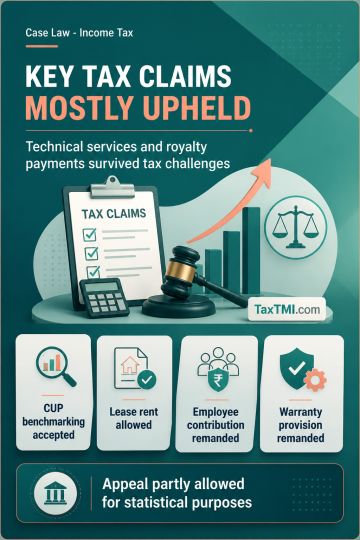
Transfer pricing and tax deductions upheld on established principles, while employee contributions and warranty provisions returned for fresh examinat...
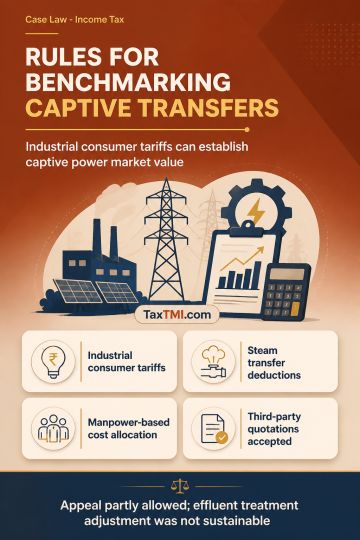
Captive transfer pricing relies on industrial consumer tariffs, while genuine quotations can benchmark effluent treatment transfers under the Other Me...
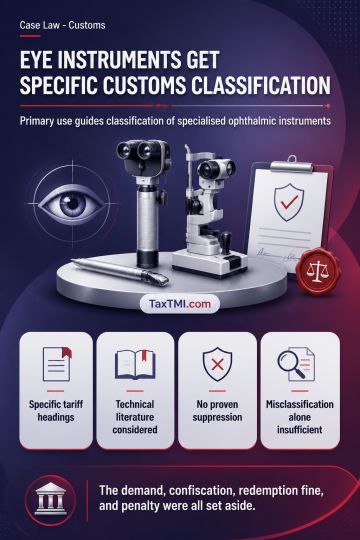
Specific tariff classification for ophthalmic instruments and extended limitation principles determine the treatment of duty demands, confiscation, an...
Interpretation of Section 11D of the Central Excise Act, 1944, regarding the recovery of amounts collected as excise duty but not deposited with the government. The key points are: If an assessee collects excise duty or any amount representing excise duty, they cannot retain it and must deposit it with the government. Section 11D can be invoked to recover such amounts. In this case, the appellant made a pre-deposit of Rs. 1 crore and later issued supplementary invoices passing on the burden to another party. The demand raised in the show cause notice invoked Section 11D, not Rule 14 of the Cenvat Credit Rules, 2004. Section 11D is applicable only when excise duty or an amount representing excise duty is collected but not deposited with the government. The impugned order was set aside, and the appeal was allowed by the CESTAT (Appellate Tribunal).
Interpretation of Section 11D of the Central Excise Act, 1944, regarding the recovery of amounts collected as excise duty but not deposited with the government. The key points are: If an assessee collects excise duty or any amount representing excise duty, they cannot retain it and must deposit it with the government. Section 11D can be invoked to recover such amounts. In this case, the appellant made a pre-deposit of Rs. 1 crore and later issued supplementary invoices passing on the burden to another party. The demand raised in the show cause notice invoked Section 11D, not Rule 14 of the Cenvat Credit Rules, 2004. Section 11D is applicable only when excise duty or an amount representing excise duty is collected but not deposited with the government. The impugned order was set aside, and the appeal was allowed by the CESTAT (Appellate Tribunal).
Note: It is a system-generated summary and is for quick reference only.
 TaxTMI
 of 4805
















 Join Channel


 TaxTMI