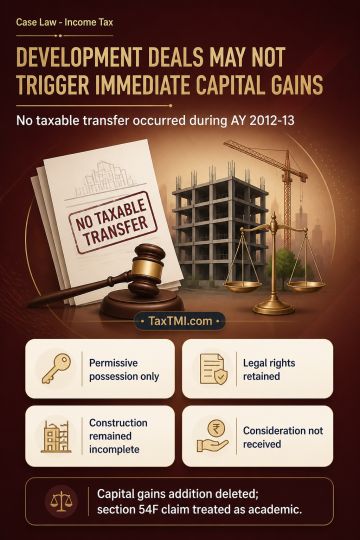
Development agreements require legal possession or effective enjoyment for capital gains transfer; permissive possession and deferred consideration de...
Prolonged sterilisation of development rights supports capital-gains treatment, while business-income disallowances cannot govern capital-gains comput...
Additional evidence in transfer pricing dispute leads to fresh examination, while tax deductions, TDS credit, fee and refund interest require verifica...
Category II AIF pass-through taxation preserves non-business income character; investment receipts cannot be reclassified without applying recognised ...
Mutual fund maturity rules require proper rollover, redemption, disclosure, and due diligence; investor gains cannot excuse regulatory breaches or pen...
The High Court ruled that mere reflection of an entry in the balance sheet liability column cannot constitute an 'agreement' for payment of gratuity u/s 4(5) of the Payment of Gratuity Act. An underlying document or contract between the parties explicitly agreeing to pay gratuity is necessary. In the absence of such an agreement or contract, the stray entry made by the petitioners themselves in the company's balance sheet, days before selling their stake, cannot create a liability for gratuity payment. The petitioners' names were not included in the LIC gratuity insurance policy, and no evidence suggested previous directors received gratuity. Therefore, the petitioners' claim for gratuity amounting to Rs. 1.21 crores was untenable and rightly rejected by the authorities.
The High Court ruled that mere reflection of an entry in the balance sheet liability column cannot constitute an 'agreement' for payment of gratuity u/s 4(5) of the Payment of Gratuity Act. An underlying document or contract between the parties explicitly agreeing to pay gratuity is necessary. In the absence of such an agreement or contract, the stray entry made by the petitioners themselves in the company's balance sheet, days before selling their stake, cannot create a liability for gratuity payment. The petitioners' names were not included in the LIC gratuity insurance policy, and no evidence suggested previous directors received gratuity. Therefore, the petitioners' claim for gratuity amounting to Rs. 1.21 crores was untenable and rightly rejected by the authorities.
Note: It is a system-generated summary and is for quick reference only.
 TaxTMI
  TaxTMI
 of 4809














 Join Channel




