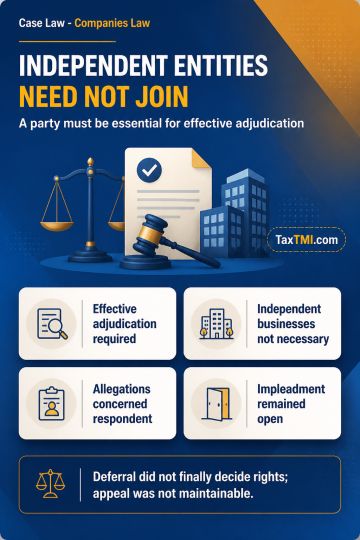
Necessary-party requirements limit impleadment of independent entities, while deferred consideration does not create an appealable adverse determinati...
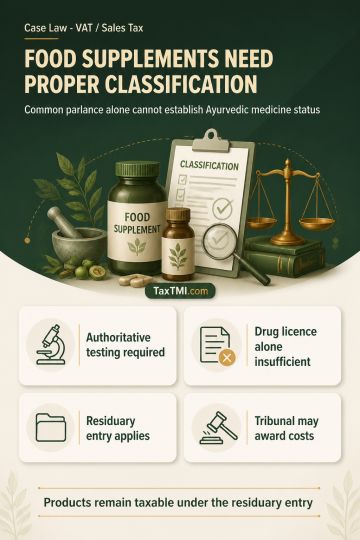
Food supplement classification requires common parlance and authoritative tests, preventing treatment as proprietary Ayurvedic medicines without suppo...
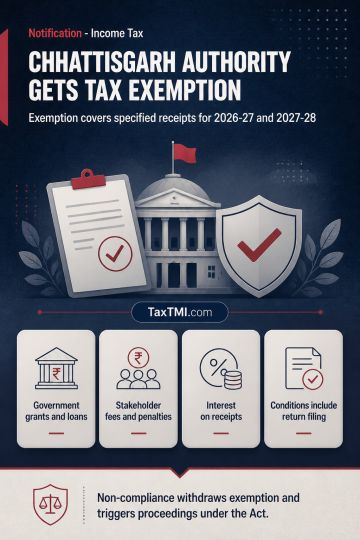
Specified regulatory authority income receives conditional tax exemption, subject to non-commercial activity, unchanged income character, and return f...
Tax exemption for regulatory authority income applies retrospectively, subject to non-commercial activity, unchanged income sources, and return-filing...
Input tax credit conditions remain constitutionally valid, with eligible recipient claims considered under GST circulars and retrospective filing dead...
Invoking the extended period of limitation u/s 11A(1) of the Central Excise Act for recovery of unpaid duty. The key points are: The department alleged suppression of facts by the appellant with intent to evade duty payment, invoking the 5-year limitation period instead of the normal 1-year period. However, the Commissioner did not provide adequate reasoning or consider the appellant's reply regarding the complex nature of classification. The Tribunal examined the Supreme Court's interpretation in Pushpam Pharmaceuticals case, which held that to invoke extended limitation, suppression of facts must be deliberate to escape duty payment. Mere difference of opinion between department and assessee on duty liability cannot be construed as willful suppression. The Tribunal found the Commissioner's order invoking extended limitation period without proper examination as unsustainable and set it aside, allowing the appeal.
Invoking the extended period of limitation u/s 11A(1) of the Central Excise Act for recovery of unpaid duty. The key points are: The department alleged suppression of facts by the appellant with intent to evade duty payment, invoking the 5-year limitation period instead of the normal 1-year period. However, the Commissioner did not provide adequate reasoning or consider the appellant's reply regarding the complex nature of classification. The Tribunal examined the Supreme Court's interpretation in Pushpam Pharmaceuticals case, which held that to invoke extended limitation, suppression of facts must be deliberate to escape duty payment. Mere difference of opinion between department and assessee on duty liability cannot be construed as willful suppression. The Tribunal found the Commissioner's order invoking extended limitation period without proper examination as unsustainable and set it aside, allowing the appeal.
Note: It is a system-generated summary and is for quick reference only.
 TaxTMI
 of 4792









 Join Channel


 TaxTMI