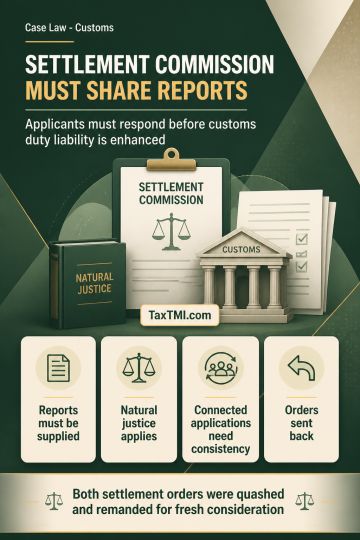
Opportunity to respond to jurisdictional reports is mandatory before customs settlement duty enhancement; connected applications require consistent ad...
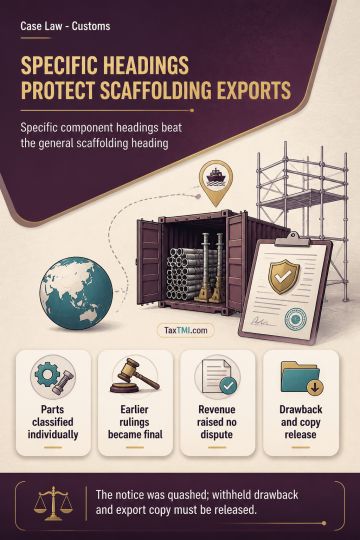
Specific customs headings for scaffolding components prevail over general classification, invalidating misclassification proceedings and enabling with...
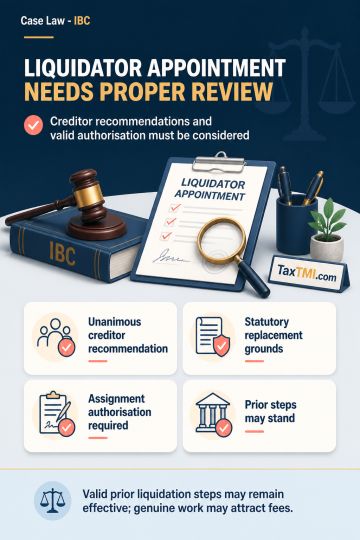
Liquidator appointment under Section 34 requires consideration of creditor recommendations, valid professional authorisation, and preservation of vali...
Page of 4790
Press 'Enter' after typing page number.
361 to 380 of 95794 Results
❮
❯
❯❯
0 / 200
Expand Note
Add to Folder
No Folders have been created
+
Are you sure you want to delete "My most important" ?
Invoking the extended period of limitation u/s 11A(1) of the Central Excise Act for recovery of unpaid duty. The key points are: The department alleged suppression of facts by the appellant with intent to evade duty payment, invoking the 5-year limitation period instead of the normal 1-year period. However, the Commissioner did not provide adequate reasoning or consider the appellant's reply regarding the complex nature of classification. The Tribunal examined the Supreme Court's interpretation in Pushpam Pharmaceuticals case, which held that to invoke extended limitation, suppression of facts must be deliberate to escape duty payment. Mere difference of opinion between department and assessee on duty liability cannot be construed as willful suppression. The Tribunal found the Commissioner's order invoking extended limitation period without proper examination as unsustainable and set it aside, allowing the appeal.
Invoking the extended period of limitation u/s 11A(1) of the Central Excise Act for recovery of unpaid duty. The key points are: The department alleged suppression of facts by the appellant with intent to evade duty payment, invoking the 5-year limitation period instead of the normal 1-year period. However, the Commissioner did not provide adequate reasoning or consider the appellant's reply regarding the complex nature of classification. The Tribunal examined the Supreme Court's interpretation in Pushpam Pharmaceuticals case, which held that to invoke extended limitation, suppression of facts must be deliberate to escape duty payment. Mere difference of opinion between department and assessee on duty liability cannot be construed as willful suppression. The Tribunal found the Commissioner's order invoking extended limitation period without proper examination as unsustainable and set it aside, allowing the appeal.
Note: It is a system-generated summary and is for quick reference only.
 TaxTMI
 of 4790



 Join Channel


 TaxTMI