Prolonged sterilisation of development rights supports capital-gains treatment, while business-income disallowances cannot govern capital-gains comput...
Additional evidence in transfer pricing dispute leads to fresh examination, while tax deductions, TDS credit, fee and refund interest require verifica...
Category II AIF pass-through taxation preserves non-business income character; investment receipts cannot be reclassified without applying recognised ...
Mutual fund maturity rules require proper rollover, redemption, disclosure, and due diligence; investor gains cannot excuse regulatory breaches or pen...
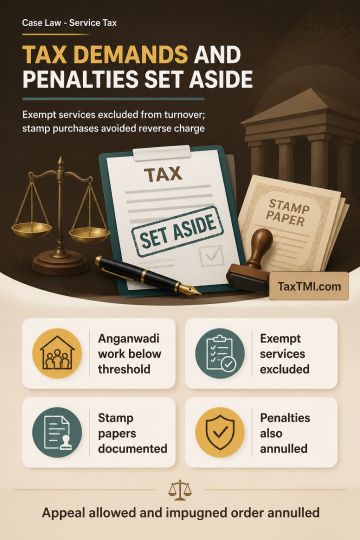
Threshold exemption excludes exempt services, while stamp-paper purchases avoid reverse charge; consequential service tax penalties were also set asid...
This is a summary of a tax case dealing with the deduction u/s 80P(2)(vi) of the Income Tax Act for income earned by cooperative societies from the collective disposal of labor of their members. The key points are: The assessee cooperative society was engaged in civil works, which primarily involved collective labor services, although materials were also procured incidentally. The dominant purpose was collective disposal of members' labor. Even when bidding for tenders requiring both labor and materials, the focus remained on providing collective labor services competitively. The Tribunal held that the assessee's activities cumulatively fell within the scope of "collective disposal of labor of its members" u/s 80P(2)(a)(vi), entitling it to the deduction. The nature of the broad activity was collective labor services, with material purchases being ancillary. The society earned profits through collective labor sacrifices. The Tribunal distinguished the case from a cited precedent involving toddy business, as the dominating purpose here was collective labor disposal, not procurement and sale of materials. The Revenue's contention about a single member was rejected due to lack of evidence and findings by lower authorities. The Tribunal decided in favor of the assessee.
This is a summary of a tax case dealing with the deduction u/s 80P(2)(vi) of the Income Tax Act for income earned by cooperative societies from the collective disposal of labor of their members. The key points are: The assessee cooperative society was engaged in civil works, which primarily involved collective labor services, although materials were also procured incidentally. The dominant purpose was collective disposal of members' labor. Even when bidding for tenders requiring both labor and materials, the focus remained on providing collective labor services competitively. The Tribunal held that the assessee's activities cumulatively fell within the scope of "collective disposal of labor of its members" u/s 80P(2)(a)(vi), entitling it to the deduction. The nature of the broad activity was collective labor services, with material purchases being ancillary. The society earned profits through collective labor sacrifices. The Tribunal distinguished the case from a cited precedent involving toddy business, as the dominating purpose here was collective labor disposal, not procurement and sale of materials. The Revenue's contention about a single member was rejected due to lack of evidence and findings by lower authorities. The Tribunal decided in favor of the assessee.
Note: It is a system-generated summary and is for quick reference only.
 TaxTMI
 of 4805


















 Join Channel


 TaxTMI
