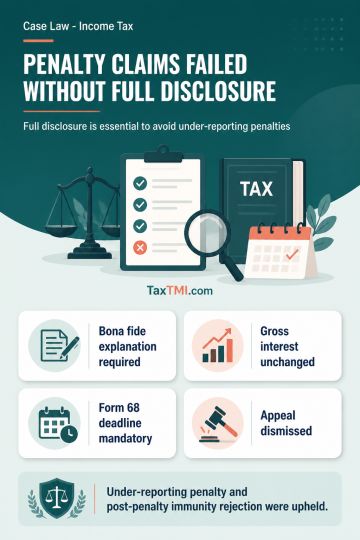
Bona fide disclosure requirements govern under-reporting penalties, and post-penalty immunity applications cannot secure available statutory protectio...
Certificate-of-origin verification procedure governs preferential customs benefits; denial without retroactive verification was set aside with consequ...
Disciplinary Committee jurisdiction and mandatory investigation requirements invalidated cancellation of an insolvency professional's registration and...
Retention of seized property survives where recorded reasons support proceeds of crime, while stayed investigation periods are excluded from limitatio...
Specified income of Baddi Barotiwala Nalagarh Development Authority receives conditional tax exemption, retrospectively covering its designated assess...
Page of 4805
Press 'Enter' after typing page number.
1221 to 1240 of 96092 Results
❮
❯
❯❯
0 / 200
Expand Note
Add to Folder
No Folders have been created
+
Are you sure you want to delete "My most important" ?
This is a summary of a tax case dealing with the deduction u/s 80P(2)(vi) of the Income Tax Act for income earned by cooperative societies from the collective disposal of labor of their members. The key points are: The assessee cooperative society was engaged in civil works, which primarily involved collective labor services, although materials were also procured incidentally. The dominant purpose was collective disposal of members' labor. Even when bidding for tenders requiring both labor and materials, the focus remained on providing collective labor services competitively. The Tribunal held that the assessee's activities cumulatively fell within the scope of "collective disposal of labor of its members" u/s 80P(2)(a)(vi), entitling it to the deduction. The nature of the broad activity was collective labor services, with material purchases being ancillary. The society earned profits through collective labor sacrifices. The Tribunal distinguished the case from a cited precedent involving toddy business, as the dominating purpose here was collective labor disposal, not procurement and sale of materials. The Revenue's contention about a single member was rejected due to lack of evidence and findings by lower authorities. The Tribunal decided in favor of the assessee.
This is a summary of a tax case dealing with the deduction u/s 80P(2)(vi) of the Income Tax Act for income earned by cooperative societies from the collective disposal of labor of their members. The key points are: The assessee cooperative society was engaged in civil works, which primarily involved collective labor services, although materials were also procured incidentally. The dominant purpose was collective disposal of members' labor. Even when bidding for tenders requiring both labor and materials, the focus remained on providing collective labor services competitively. The Tribunal held that the assessee's activities cumulatively fell within the scope of "collective disposal of labor of its members" u/s 80P(2)(a)(vi), entitling it to the deduction. The nature of the broad activity was collective labor services, with material purchases being ancillary. The society earned profits through collective labor sacrifices. The Tribunal distinguished the case from a cited precedent involving toddy business, as the dominating purpose here was collective labor disposal, not procurement and sale of materials. The Revenue's contention about a single member was rejected due to lack of evidence and findings by lower authorities. The Tribunal decided in favor of the assessee.
Note: It is a system-generated summary and is for quick reference only.
 TaxTMI
 of 4805



















 Join Channel


 TaxTMI