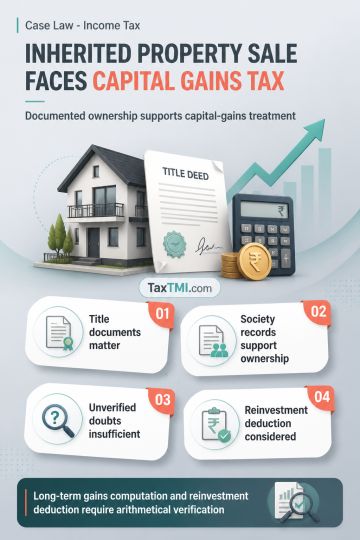
Inherited property sale proceeds require capital-gains treatment where ownership is supported by evidence, not suspicion or unverified signature doubt...
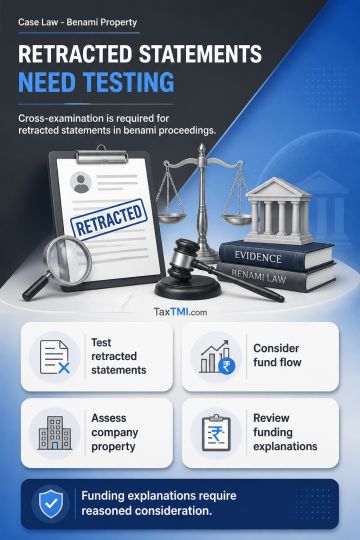
Cross-examination of retracted statements is essential where foundational evidence supports a benami allegation and documented funding explanations re...
Capital-goods exemption covers plant-modernisation accessories, while the import restriction applies only to earlier capital-goods components and spar...
Constitutional judicial review permits challenges to ECIRs and connected money-laundering proceedings where coercive action affects fundamental intere...
This is a summary of a tax case dealing with the deduction u/s 80P(2)(vi) of the Income Tax Act for income earned by cooperative societies from the collective disposal of labor of their members. The key points are: The assessee cooperative society was engaged in civil works, which primarily involved collective labor services, although materials were also procured incidentally. The dominant purpose was collective disposal of members' labor. Even when bidding for tenders requiring both labor and materials, the focus remained on providing collective labor services competitively. The Tribunal held that the assessee's activities cumulatively fell within the scope of "collective disposal of labor of its members" u/s 80P(2)(a)(vi), entitling it to the deduction. The nature of the broad activity was collective labor services, with material purchases being ancillary. The society earned profits through collective labor sacrifices. The Tribunal distinguished the case from a cited precedent involving toddy business, as the dominating purpose here was collective labor disposal, not procurement and sale of materials. The Revenue's contention about a single member was rejected due to lack of evidence and findings by lower authorities. The Tribunal decided in favor of the assessee.
This is a summary of a tax case dealing with the deduction u/s 80P(2)(vi) of the Income Tax Act for income earned by cooperative societies from the collective disposal of labor of their members. The key points are: The assessee cooperative society was engaged in civil works, which primarily involved collective labor services, although materials were also procured incidentally. The dominant purpose was collective disposal of members' labor. Even when bidding for tenders requiring both labor and materials, the focus remained on providing collective labor services competitively. The Tribunal held that the assessee's activities cumulatively fell within the scope of "collective disposal of labor of its members" u/s 80P(2)(a)(vi), entitling it to the deduction. The nature of the broad activity was collective labor services, with material purchases being ancillary. The society earned profits through collective labor sacrifices. The Tribunal distinguished the case from a cited precedent involving toddy business, as the dominating purpose here was collective labor disposal, not procurement and sale of materials. The Revenue's contention about a single member was rejected due to lack of evidence and findings by lower authorities. The Tribunal decided in favor of the assessee.
Note: It is a system-generated summary and is for quick reference only.
 TaxTMI
 of 4792

















 Join Channel


 TaxTMI