Development agreements require legal possession or effective enjoyment for capital gains transfer; permissive possession and deferred consideration de...
Prolonged sterilisation of development rights supports capital-gains treatment, while business-income disallowances cannot govern capital-gains comput...
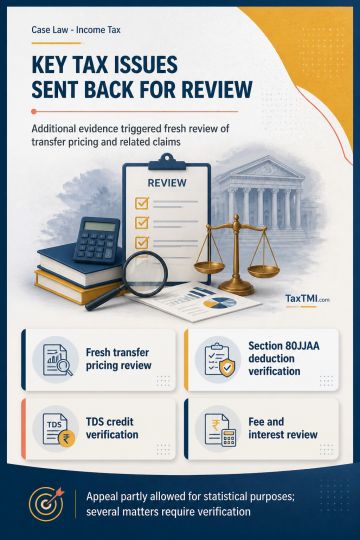
Additional evidence in transfer pricing dispute leads to fresh examination, while tax deductions, TDS credit, fee and refund interest require verifica...
Category II AIF pass-through taxation preserves non-business income character; investment receipts cannot be reclassified without applying recognised ...
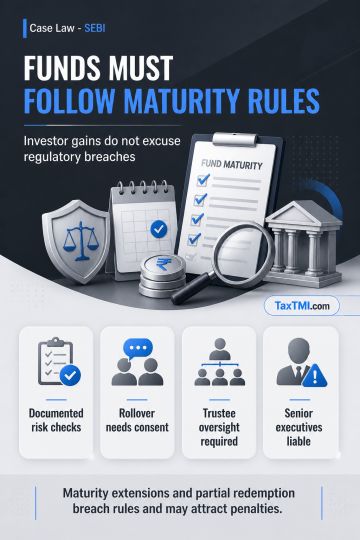
Mutual fund maturity rules require proper rollover, redemption, disclosure, and due diligence; investor gains cannot excuse regulatory breaches or pen...
Page of 4798
Press 'Enter' after typing page number.
1161 to 1180 of 95957 Results
❮
❯
❯❯
0 / 200
Expand Note
Add to Folder
No Folders have been created
+
Are you sure you want to delete "My most important" ?
Insolvency and BankruptcyAugust 27, 2024Case LawsHC
Maintainability of an interim application seeking summary judgment under the Code of Civil Procedure for enforcing claims arising from bunker supplies made to defendant vessels. The court held that the plaintiff has proceeded in rem against the defendant vessel, claimed to be beneficially owned by the defendant, for a defined class of maritime claim under the Admiralty Act. The court rejected the defendant's contention that the plaintiff's claim is an in personam claim, precluding an action in rem against the res. The court clarified that Section 14 of the Insolvency and Bankruptcy Code does not prohibit an action in rem or continuation of in rem proceedings against a maritime vessel. To affect an arrest under the Admiralty Act, the owner of the vessel must be liable for a maritime claim and must be the owner when the arrest is effected, with no restriction on a time charterer being the owner. However, the plaintiff cannot seek summary judgment without evidence for establishing the defendant as the real owner of the vessel for certain supplies. The suit shall continue against the defendant for those supplies.
Maintainability of an interim application seeking summary judgment under the Code of Civil Procedure for enforcing claims arising from bunker supplies made to defendant vessels. The court held that the plaintiff has proceeded in rem against the defendant vessel, claimed to be beneficially owned by the defendant, for a defined class of maritime claim under the Admiralty Act. The court rejected the defendant's contention that the plaintiff's claim is an in personam claim, precluding an action in rem against the res. The court clarified that Section 14 of the Insolvency and Bankruptcy Code does not prohibit an action in rem or continuation of in rem proceedings against a maritime vessel. To affect an arrest under the Admiralty Act, the owner of the vessel must be liable for a maritime claim and must be the owner when the arrest is effected, with no restriction on a time charterer being the owner. However, the plaintiff cannot seek summary judgment without evidence for establishing the defendant as the real owner of the vessel for certain supplies. The suit shall continue against the defendant for those supplies.
Note: It is a system-generated summary and is for quick reference only.
 TaxTMI
 of 4798
















 Join Channel


 TaxTMI