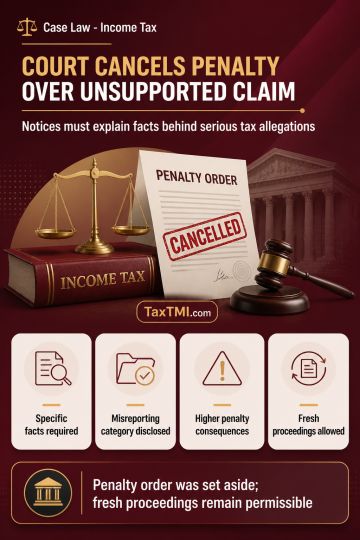
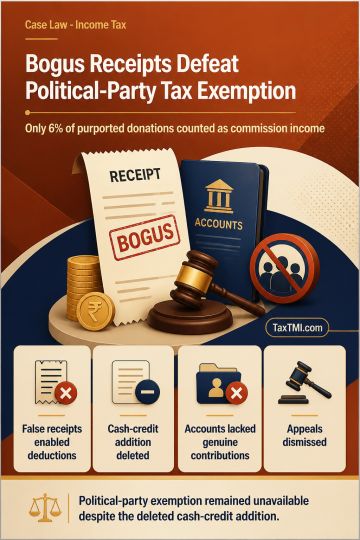
Bogus donation receipts justified commission income assessment and defeated political-party tax exemption for inaccurate accounts and reporting failur...
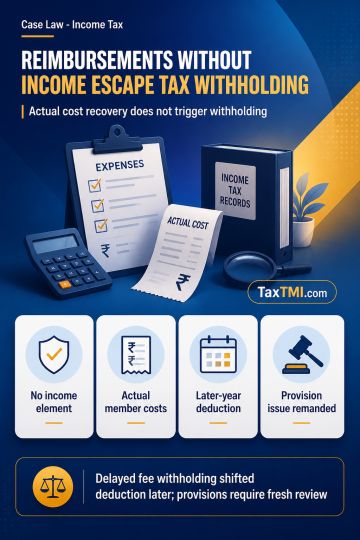
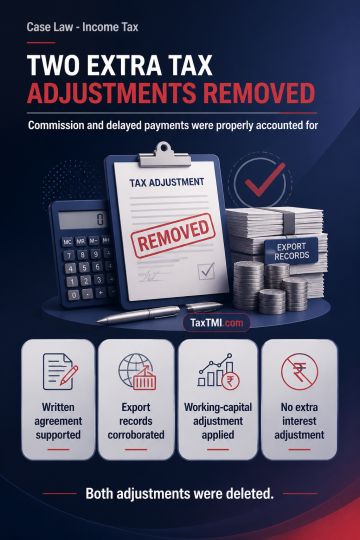
Pure reimbursement without income element escapes tax withholding, while delayed withholding and unsupported provisions face deferred or renewed scrut...
Public benefit requirement defeats charitable registration where residents' association services are reciprocal, member-only facilities governed by mu...
Exempt-income expenditure disallowance is confined to investments that actually generated exempt income, while supported business expenses remain dedu...
Insolvency and BankruptcyAugust 27, 2024Case LawsHC
Maintainability of an interim application seeking summary judgment under the Code of Civil Procedure for enforcing claims arising from bunker supplies made to defendant vessels. The court held that the plaintiff has proceeded in rem against the defendant vessel, claimed to be beneficially owned by the defendant, for a defined class of maritime claim under the Admiralty Act. The court rejected the defendant's contention that the plaintiff's claim is an in personam claim, precluding an action in rem against the res. The court clarified that Section 14 of the Insolvency and Bankruptcy Code does not prohibit an action in rem or continuation of in rem proceedings against a maritime vessel. To affect an arrest under the Admiralty Act, the owner of the vessel must be liable for a maritime claim and must be the owner when the arrest is effected, with no restriction on a time charterer being the owner. However, the plaintiff cannot seek summary judgment without evidence for establishing the defendant as the real owner of the vessel for certain supplies. The suit shall continue against the defendant for those supplies.
Maintainability of an interim application seeking summary judgment under the Code of Civil Procedure for enforcing claims arising from bunker supplies made to defendant vessels. The court held that the plaintiff has proceeded in rem against the defendant vessel, claimed to be beneficially owned by the defendant, for a defined class of maritime claim under the Admiralty Act. The court rejected the defendant's contention that the plaintiff's claim is an in personam claim, precluding an action in rem against the res. The court clarified that Section 14 of the Insolvency and Bankruptcy Code does not prohibit an action in rem or continuation of in rem proceedings against a maritime vessel. To affect an arrest under the Admiralty Act, the owner of the vessel must be liable for a maritime claim and must be the owner when the arrest is effected, with no restriction on a time charterer being the owner. However, the plaintiff cannot seek summary judgment without evidence for establishing the defendant as the real owner of the vessel for certain supplies. The suit shall continue against the defendant for those supplies.
Note: It is a system-generated summary and is for quick reference only.
 TaxTMI
 of 4790












 Join Channel


 TaxTMI
