Inherited property sale proceeds require capital-gains treatment where ownership is supported by evidence, not suspicion or unverified signature doubt...
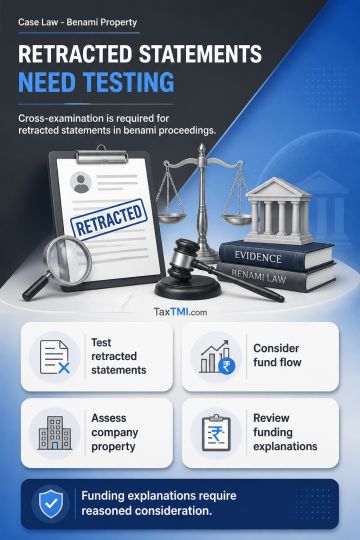
Cross-examination of retracted statements is essential where foundational evidence supports a benami allegation and documented funding explanations re...
Capital-goods exemption covers plant-modernisation accessories, while the import restriction applies only to earlier capital-goods components and spar...
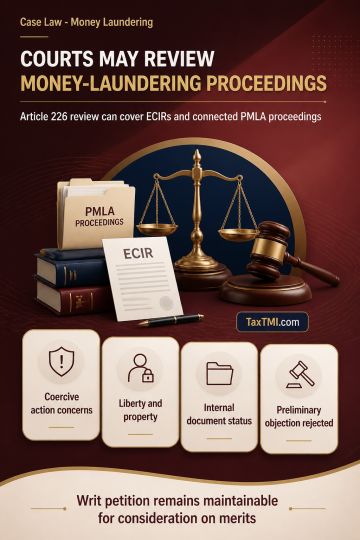
Constitutional judicial review permits challenges to ECIRs and connected money-laundering proceedings where coercive action affects fundamental intere...
The assessee's income received from Indian customers as Fee for Technical Services (FTS)/Fee for Included Services (FIS) u/s 9(1)(vii) of the Act and Article 12(4) of India-USA Double Taxation Avoidance Agreement was examined. The Assessing Officer (AO) observed that the assessee provided user-specific services involving human intervention, beyond mere content services. However, the AO's findings were self-contradictory, acknowledging the assessee as an aggregation service provider but denying its role as a mere aggregator. The AO failed to establish that the assessee provided technical services through its online platform or transferred technical knowledge, know-how, or skills to enable independent utilization by recipients. Relying on precedents, the Appellate Tribunal held that the receipts did not qualify as FIS under Article 12(4) of the India-USA tax treaty, allowing the assessee's appeals.
The assessee's income received from Indian customers as Fee for Technical Services (FTS)/Fee for Included Services (FIS) u/s 9(1)(vii) of the Act and Article 12(4) of India-USA Double Taxation Avoidance Agreement was examined. The Assessing Officer (AO) observed that the assessee provided user-specific services involving human intervention, beyond mere content services. However, the AO's findings were self-contradictory, acknowledging the assessee as an aggregation service provider but denying its role as a mere aggregator. The AO failed to establish that the assessee provided technical services through its online platform or transferred technical knowledge, know-how, or skills to enable independent utilization by recipients. Relying on precedents, the Appellate Tribunal held that the receipts did not qualify as FIS under Article 12(4) of the India-USA tax treaty, allowing the assessee's appeals.
Note: It is a system-generated summary and is for quick reference only.
 TaxTMI
 of 4784







 Join Channel


 TaxTMI