Defined public benefit can retain charitable character; registration renewal requires examining genuine activities and legal compliance, not surplus a...
Capital reduction is distinct from share buy-back, preventing buy-back tax; restructuring interest and related business deductions also survive scruti...
Transfer pricing and tax deductions upheld on established principles, while employee contributions and warranty provisions returned for fresh examinat...
Captive transfer pricing relies on industrial consumer tariffs, while genuine quotations can benchmark effluent treatment transfers under the Other Me...
Specific tariff classification for ophthalmic instruments and extended limitation principles determine the treatment of duty demands, confiscation, an...
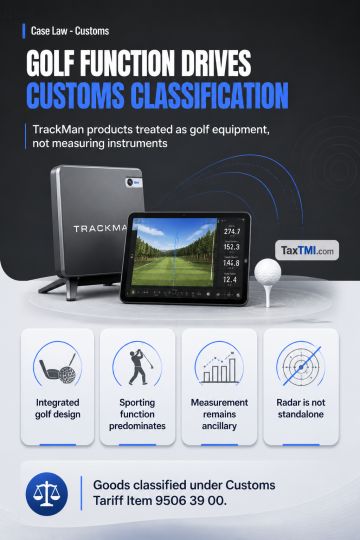
Integrated golf function determines classification, placing launch monitors and simulators under other golf equipment rather than measuring instrument...
The assessee's income received from Indian customers as Fee for Technical Services (FTS)/Fee for Included Services (FIS) u/s 9(1)(vii) of the Act and Article 12(4) of India-USA Double Taxation Avoidance Agreement was examined. The Assessing Officer (AO) observed that the assessee provided user-specific services involving human intervention, beyond mere content services. However, the AO's findings were self-contradictory, acknowledging the assessee as an aggregation service provider but denying its role as a mere aggregator. The AO failed to establish that the assessee provided technical services through its online platform or transferred technical knowledge, know-how, or skills to enable independent utilization by recipients. Relying on precedents, the Appellate Tribunal held that the receipts did not qualify as FIS under Article 12(4) of the India-USA tax treaty, allowing the assessee's appeals.
The assessee's income received from Indian customers as Fee for Technical Services (FTS)/Fee for Included Services (FIS) u/s 9(1)(vii) of the Act and Article 12(4) of India-USA Double Taxation Avoidance Agreement was examined. The Assessing Officer (AO) observed that the assessee provided user-specific services involving human intervention, beyond mere content services. However, the AO's findings were self-contradictory, acknowledging the assessee as an aggregation service provider but denying its role as a mere aggregator. The AO failed to establish that the assessee provided technical services through its online platform or transferred technical knowledge, know-how, or skills to enable independent utilization by recipients. Relying on precedents, the Appellate Tribunal held that the receipts did not qualify as FIS under Article 12(4) of the India-USA tax treaty, allowing the assessee's appeals.
Note: It is a system-generated summary and is for quick reference only.
 TaxTMI
 of 4798




















 Join Channel


 TaxTMI