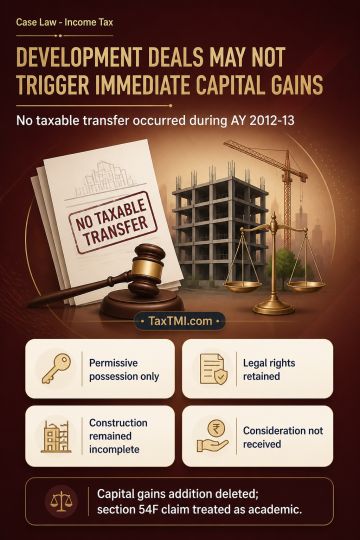
Development agreements require legal possession or effective enjoyment for capital gains transfer; permissive possession and deferred consideration de...
Prolonged sterilisation of development rights supports capital-gains treatment, while business-income disallowances cannot govern capital-gains comput...
Additional evidence in transfer pricing dispute leads to fresh examination, while tax deductions, TDS credit, fee and refund interest require verifica...
Category II AIF pass-through taxation preserves non-business income character; investment receipts cannot be reclassified without applying recognised ...
Mutual fund maturity rules require proper rollover, redemption, disclosure, and due diligence; investor gains cannot excuse regulatory breaches or pen...
The Appellate Tribunal examined the issue of invoking revisional jurisdiction u/s 263 in a case involving receipts of accommodation entries and reopening of assessment. The crux was the distinction between 'lack of inquiry' and 'inadequate inquiry' by the Assessing Officer (AO). It was held that if the AO conducted any inquiry, even if inadequate, it would not justify the Commissioner's intervention u/s 263 merely due to a different opinion. Lack of inquiry is the sole ground for exercising revisional powers. In the present case, the AO made detailed inquiries on the accommodation entry issue, which the assessee denied, and no further evidence was provided. Hence, it could not be treated as a lack of inquiry. The AO had applied their mind and accepted the assessee's explanation after reopening the case. Consequently, the Principal Commissioner was not justified in invoking revisional jurisdiction u/s 263, and the decision favored the assessee.
The Appellate Tribunal examined the issue of invoking revisional jurisdiction u/s 263 in a case involving receipts of accommodation entries and reopening of assessment. The crux was the distinction between 'lack of inquiry' and 'inadequate inquiry' by the Assessing Officer (AO). It was held that if the AO conducted any inquiry, even if inadequate, it would not justify the Commissioner's intervention u/s 263 merely due to a different opinion. Lack of inquiry is the sole ground for exercising revisional powers. In the present case, the AO made detailed inquiries on the accommodation entry issue, which the assessee denied, and no further evidence was provided. Hence, it could not be treated as a lack of inquiry. The AO had applied their mind and accepted the assessee's explanation after reopening the case. Consequently, the Principal Commissioner was not justified in invoking revisional jurisdiction u/s 263, and the decision favored the assessee.
Note: It is a system-generated summary and is for quick reference only.
 TaxTMI
 of 4794


















 Join Channel


 TaxTMI
