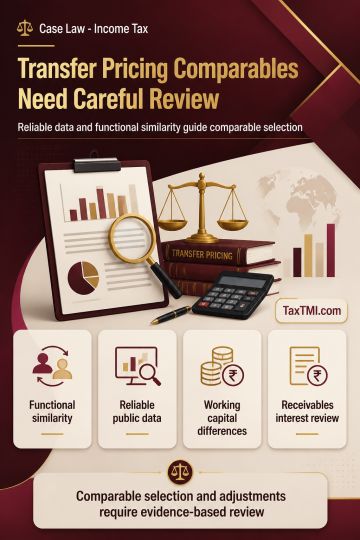
Transfer pricing comparability requires functional alignment, reliable financial data, and careful review of working capital and receivables adjustmen...
Transfer pricing rules require benchmarking corporate guarantees and associated-enterprise advances, while invalid domestic-transaction adjustments ca...
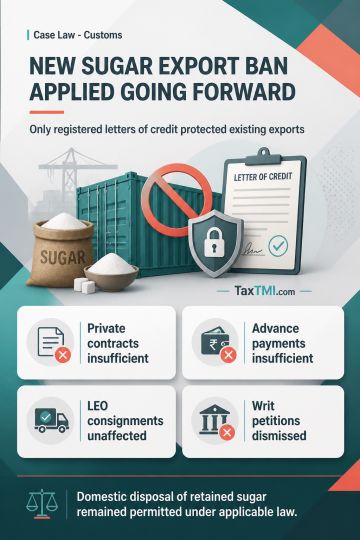
Prospective sugar export prohibition required registered letters of credit; private contracts and export quotas created no enforceable continuation ri...
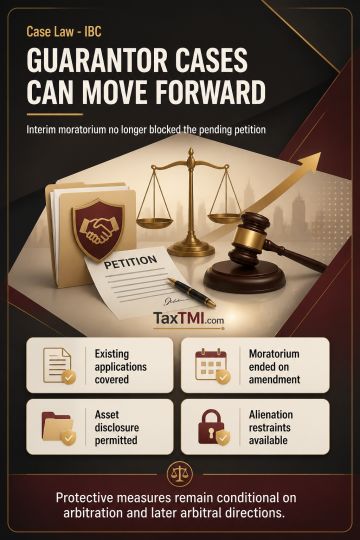
Retroactive interim-moratorium exclusion permits protective asset disclosure and preservation measures against personal guarantors pending arbitration...
Under the Insolvency and Bankruptcy Code (IBC), the Corporate Insolvency Resolution Process (CIRP) was initiated against the first petitioner-company, and a moratorium was imposed, prohibiting any creation of charge on its properties during the CIRP period. Despite this, the respondents created a charge on the petitioner's properties, violating the IBC's provisions. Subsequently, an acquisition plan for the petitioner-company was approved by the NCLT, extinguishing all existing debts, including tax dues owed to the respondents. The IBC's "Clean Slate" principle mandates the extinguishment of all government dues upon approval of a resolution/acquisition plan. The respondents' claim of priority for tax dues as "Crown Debt" was rejected. The High Court issued a mandamus, directing the removal of the respondents' charge/red entries on the petitioner's properties, as their actions were illegal and arbitrary under the IBC.
Under the Insolvency and Bankruptcy Code (IBC), the Corporate Insolvency Resolution Process (CIRP) was initiated against the first petitioner-company, and a moratorium was imposed, prohibiting any creation of charge on its properties during the CIRP period. Despite this, the respondents created a charge on the petitioner's properties, violating the IBC's provisions. Subsequently, an acquisition plan for the petitioner-company was approved by the NCLT, extinguishing all existing debts, including tax dues owed to the respondents. The IBC's "Clean Slate" principle mandates the extinguishment of all government dues upon approval of a resolution/acquisition plan. The respondents' claim of priority for tax dues as "Crown Debt" was rejected. The High Court issued a mandamus, directing the removal of the respondents' charge/red entries on the petitioner's properties, as their actions were illegal and arbitrary under the IBC.
Note: It is a system-generated summary and is for quick reference only.
 TaxTMI
 of 4782











 Join Channel


 TaxTMI