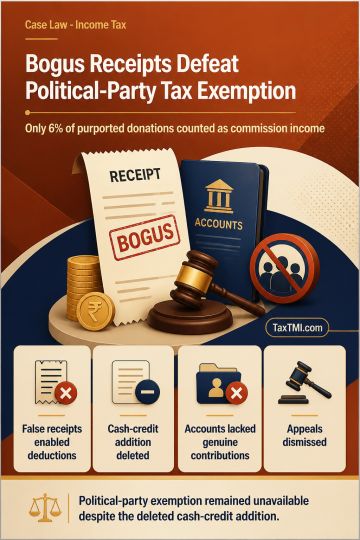
Bogus donation receipts justified commission income assessment and defeated political-party tax exemption for inaccurate accounts and reporting failur...
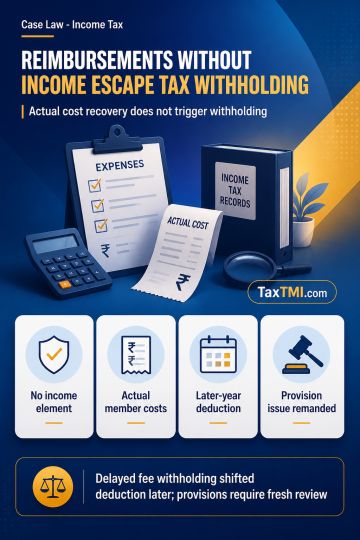
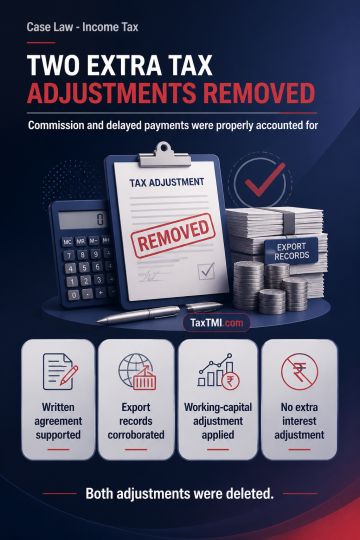
Pure reimbursement without income element escapes tax withholding, while delayed withholding and unsupported provisions face deferred or renewed scrut...
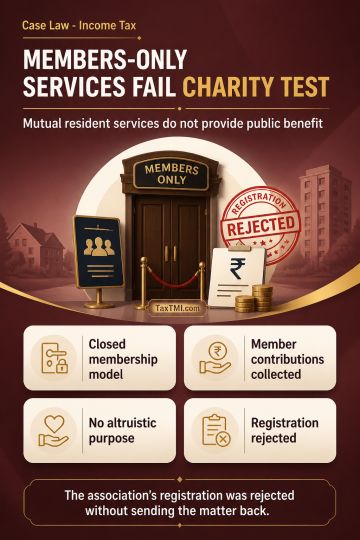
Public benefit requirement defeats charitable registration where residents' association services are reciprocal, member-only facilities governed by mu...
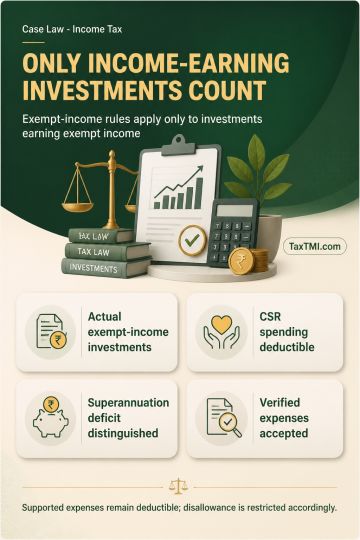
Exempt-income expenditure disallowance is confined to investments that actually generated exempt income, while supported business expenses remain dedu...
Objective characteristics and principal use govern mining-tyre classification, while fresh advance ruling applications may rely on additional technica...
Under the Insolvency and Bankruptcy Code (IBC), the Corporate Insolvency Resolution Process (CIRP) was initiated against the first petitioner-company, and a moratorium was imposed, prohibiting any creation of charge on its properties during the CIRP period. Despite this, the respondents created a charge on the petitioner's properties, violating the IBC's provisions. Subsequently, an acquisition plan for the petitioner-company was approved by the NCLT, extinguishing all existing debts, including tax dues owed to the respondents. The IBC's "Clean Slate" principle mandates the extinguishment of all government dues upon approval of a resolution/acquisition plan. The respondents' claim of priority for tax dues as "Crown Debt" was rejected. The High Court issued a mandamus, directing the removal of the respondents' charge/red entries on the petitioner's properties, as their actions were illegal and arbitrary under the IBC.
Under the Insolvency and Bankruptcy Code (IBC), the Corporate Insolvency Resolution Process (CIRP) was initiated against the first petitioner-company, and a moratorium was imposed, prohibiting any creation of charge on its properties during the CIRP period. Despite this, the respondents created a charge on the petitioner's properties, violating the IBC's provisions. Subsequently, an acquisition plan for the petitioner-company was approved by the NCLT, extinguishing all existing debts, including tax dues owed to the respondents. The IBC's "Clean Slate" principle mandates the extinguishment of all government dues upon approval of a resolution/acquisition plan. The respondents' claim of priority for tax dues as "Crown Debt" was rejected. The High Court issued a mandamus, directing the removal of the respondents' charge/red entries on the petitioner's properties, as their actions were illegal and arbitrary under the IBC.
Note: It is a system-generated summary and is for quick reference only.
 TaxTMI
 of 4788






 Join Channel


 TaxTMI