Food supplement classification requires common parlance and authoritative tests, preventing treatment as proprietary Ayurvedic medicines without suppo...
Specified regulatory authority income receives conditional tax exemption, subject to non-commercial activity, unchanged income character, and return f...
Tax exemption for regulatory authority income applies retrospectively, subject to non-commercial activity, unchanged income sources, and return-filing...
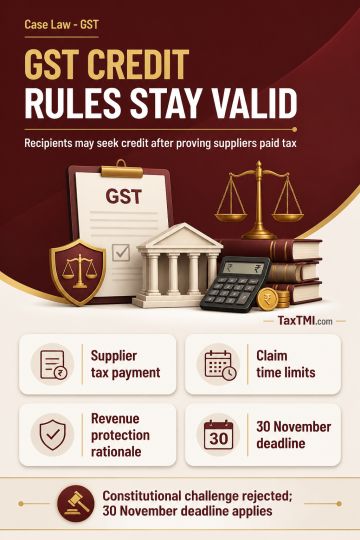
Input tax credit conditions remain constitutionally valid, with eligible recipient claims considered under GST circulars and retrospective filing dead...
Under the Insolvency and Bankruptcy Code (IBC), the Corporate Insolvency Resolution Process (CIRP) was initiated against the first petitioner-company, and a moratorium was imposed, prohibiting any creation of charge on its properties during the CIRP period. Despite this, the respondents created a charge on the petitioner's properties, violating the IBC's provisions. Subsequently, an acquisition plan for the petitioner-company was approved by the NCLT, extinguishing all existing debts, including tax dues owed to the respondents. The IBC's "Clean Slate" principle mandates the extinguishment of all government dues upon approval of a resolution/acquisition plan. The respondents' claim of priority for tax dues as "Crown Debt" was rejected. The High Court issued a mandamus, directing the removal of the respondents' charge/red entries on the petitioner's properties, as their actions were illegal and arbitrary under the IBC.
Under the Insolvency and Bankruptcy Code (IBC), the Corporate Insolvency Resolution Process (CIRP) was initiated against the first petitioner-company, and a moratorium was imposed, prohibiting any creation of charge on its properties during the CIRP period. Despite this, the respondents created a charge on the petitioner's properties, violating the IBC's provisions. Subsequently, an acquisition plan for the petitioner-company was approved by the NCLT, extinguishing all existing debts, including tax dues owed to the respondents. The IBC's "Clean Slate" principle mandates the extinguishment of all government dues upon approval of a resolution/acquisition plan. The respondents' claim of priority for tax dues as "Crown Debt" was rejected. The High Court issued a mandamus, directing the removal of the respondents' charge/red entries on the petitioner's properties, as their actions were illegal and arbitrary under the IBC.
Note: It is a system-generated summary and is for quick reference only.
 TaxTMI
 of 4788
















 Join Channel


 TaxTMI