Receipt of immovable property requires actual possession or enjoyment; redevelopment allotments exchanged for tenancy rights fall outside deemed incom...
Section 80P deduction covers Souharda credit societies, including qualifying surplus-deposit interest, subject to member KYC verification for cash dep...
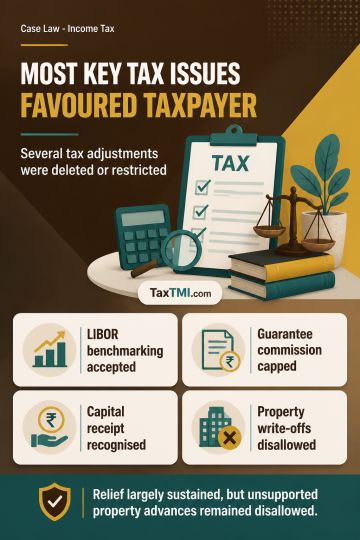
Transfer-pricing benchmarking and capital-receipt principles sustained taxpayer relief, while unsupported property-advance write-offs remained disallo...
Petitioner sought regular bail in case involving alleged wrongful Input Tax Credit (ITC) availed using fictitious invoices from non-existent/suspicious firms. As per Section 132(1)(b) and (c) of HGST/CGST Act, issuing invoice without supply or availing ITC using such invoice, where tax evaded or ITC wrongly availed exceeds Rs. 500 lakhs, is punishable with up to 5 years imprisonment and fine. Show cause notice u/s 74(1) issued to petitioner is yet to be adjudicated upon to determine exact tax liability. Determination of tax liability is subject to challenge before tribunals/courts and does not fall within criminal court's realm. Another firm also issued notice jointly with petitioner, whose liability may reduce petitioner's liability. Considering maximum 5 years punishment u/s 132 and pending adjudication of tax liability, petitioner directed to be released on regular bail on executing personal bonds with two solvent sureties of Rs. 50 lakhs each, surrendering passport and not leaving country without court's permission during trial.
Petitioner sought regular bail in case involving alleged wrongful Input Tax Credit (ITC) availed using fictitious invoices from non-existent/suspicious firms. As per Section 132(1)(b) and (c) of HGST/CGST Act, issuing invoice without supply or availing ITC using such invoice, where tax evaded or ITC wrongly availed exceeds Rs. 500 lakhs, is punishable with up to 5 years imprisonment and fine. Show cause notice u/s 74(1) issued to petitioner is yet to be adjudicated upon to determine exact tax liability. Determination of tax liability is subject to challenge before tribunals/courts and does not fall within criminal court's realm. Another firm also issued notice jointly with petitioner, whose liability may reduce petitioner's liability. Considering maximum 5 years punishment u/s 132 and pending adjudication of tax liability, petitioner directed to be released on regular bail on executing personal bonds with two solvent sureties of Rs. 50 lakhs each, surrendering passport and not leaving country without court's permission during trial.
Note: It is a system-generated summary and is for quick reference only.
 TaxTMI
 of 4805











 Join Channel


 TaxTMI
