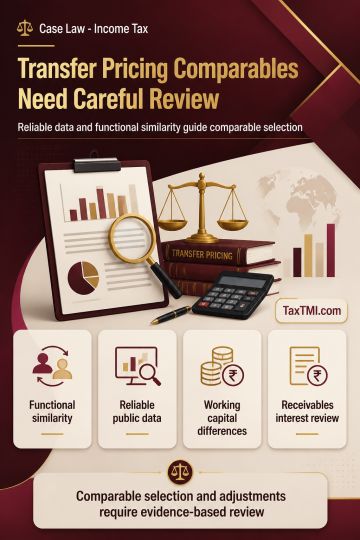
Transfer pricing comparability requires functional alignment, reliable financial data, and careful review of working capital and receivables adjustmen...
Transfer pricing rules require benchmarking corporate guarantees and associated-enterprise advances, while invalid domestic-transaction adjustments ca...
Prospective sugar export prohibition required registered letters of credit; private contracts and export quotas created no enforceable continuation ri...
Retroactive interim-moratorium exclusion permits protective asset disclosure and preservation measures against personal guarantors pending arbitration...
The assessment order passed u/s 153C was erroneous and prejudicial to the Revenue's interest. The Assessing Officer initiated penalty proceedings u/s 271AAC instead of Section 271(1)(c). The order lacked recording of satisfaction that the assessee concealed income or furnished inaccurate particulars. Without such satisfaction recorded, the Principal Commissioner's revision u/s 263 is untenable, as per the Madras High Court's decision in Chennai Metro Rail Ltd. The authorities can levy penalty u/s 271(1) during assessment proceedings, but the revisionary power u/s 263 cannot be exercised to direct penalty initiation, creating uncertainty. The Tribunal relied on the Madras High Court's decisions in Chennai Metro Rail Ltd. and C.R.K. Swamy, setting aside the impugned revision order due to the absence of a finding on concealment or inaccurate particulars. The assessee's appeal was allowed.
The assessment order passed u/s 153C was erroneous and prejudicial to the Revenue's interest. The Assessing Officer initiated penalty proceedings u/s 271AAC instead of Section 271(1)(c). The order lacked recording of satisfaction that the assessee concealed income or furnished inaccurate particulars. Without such satisfaction recorded, the Principal Commissioner's revision u/s 263 is untenable, as per the Madras High Court's decision in Chennai Metro Rail Ltd. The authorities can levy penalty u/s 271(1) during assessment proceedings, but the revisionary power u/s 263 cannot be exercised to direct penalty initiation, creating uncertainty. The Tribunal relied on the Madras High Court's decisions in Chennai Metro Rail Ltd. and C.R.K. Swamy, setting aside the impugned revision order due to the absence of a finding on concealment or inaccurate particulars. The assessee's appeal was allowed.
Note: It is a system-generated summary and is for quick reference only.
 TaxTMI
 of 4782


















 Join Channel


 TaxTMI