Defined public benefit can retain charitable character; registration renewal requires examining genuine activities and legal compliance, not surplus a...
Capital reduction is distinct from share buy-back, preventing buy-back tax; restructuring interest and related business deductions also survive scruti...
Transfer pricing and tax deductions upheld on established principles, while employee contributions and warranty provisions returned for fresh examinat...
Captive transfer pricing relies on industrial consumer tariffs, while genuine quotations can benchmark effluent treatment transfers under the Other Me...
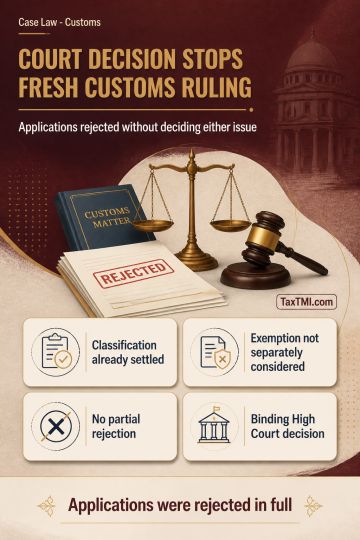
Specific tariff classification for ophthalmic instruments and extended limitation principles determine the treatment of duty demands, confiscation, an...
Integrated golf function determines classification, placing launch monitors and simulators under other golf equipment rather than measuring instrument...
The assessment order passed u/s 153C was erroneous and prejudicial to the Revenue's interest. The Assessing Officer initiated penalty proceedings u/s 271AAC instead of Section 271(1)(c). The order lacked recording of satisfaction that the assessee concealed income or furnished inaccurate particulars. Without such satisfaction recorded, the Principal Commissioner's revision u/s 263 is untenable, as per the Madras High Court's decision in Chennai Metro Rail Ltd. The authorities can levy penalty u/s 271(1) during assessment proceedings, but the revisionary power u/s 263 cannot be exercised to direct penalty initiation, creating uncertainty. The Tribunal relied on the Madras High Court's decisions in Chennai Metro Rail Ltd. and C.R.K. Swamy, setting aside the impugned revision order due to the absence of a finding on concealment or inaccurate particulars. The assessee's appeal was allowed.
The assessment order passed u/s 153C was erroneous and prejudicial to the Revenue's interest. The Assessing Officer initiated penalty proceedings u/s 271AAC instead of Section 271(1)(c). The order lacked recording of satisfaction that the assessee concealed income or furnished inaccurate particulars. Without such satisfaction recorded, the Principal Commissioner's revision u/s 263 is untenable, as per the Madras High Court's decision in Chennai Metro Rail Ltd. The authorities can levy penalty u/s 271(1) during assessment proceedings, but the revisionary power u/s 263 cannot be exercised to direct penalty initiation, creating uncertainty. The Tribunal relied on the Madras High Court's decisions in Chennai Metro Rail Ltd. and C.R.K. Swamy, setting aside the impugned revision order due to the absence of a finding on concealment or inaccurate particulars. The assessee's appeal was allowed.
Note: It is a system-generated summary and is for quick reference only.
 TaxTMI
 of 4798





















 Join Channel


 TaxTMI
