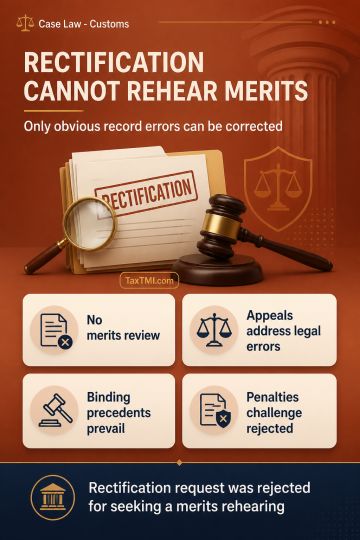
Rectification of mistake remains limited to self-evident record errors, preventing merits review through miscellaneous applications and preserving fin...
Tender creditworthiness conditions may extend to de facto Promoter Directors, with post-participation challenges generally barred absent arbitrariness...
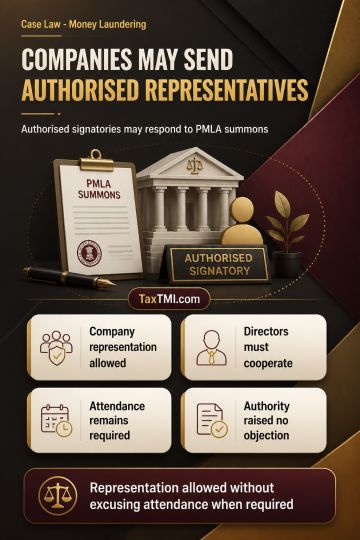
Corporate representation in PMLA summons proceedings permitted through an authorised signatory, subject to directors' continuing cooperation and atten...
Helicopter charter classification requires effective control analysis, while territorial performance, reasoned credit orders and wilful suppression de...
Specified fund definition expands PAN exemption eligibility for registered alternative investment funds and qualifying International Financial Service...
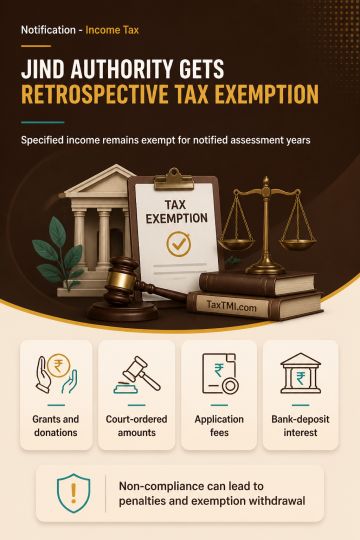
Tax exemption for specified legal-services authority income applies retrospectively, subject to non-commercial activity, unchanged income sources, and...
Page of 4792
Press 'Enter' after typing page number.
701 to 720 of 95833 Results
❮
❯
❯❯
0 / 200
Expand Note
Add to Folder
No Folders have been created
+
Are you sure you want to delete "My most important" ?
The assessment order passed u/s 153C was erroneous and prejudicial to the Revenue's interest. The Assessing Officer initiated penalty proceedings u/s 271AAC instead of Section 271(1)(c). The order lacked recording of satisfaction that the assessee concealed income or furnished inaccurate particulars. Without such satisfaction recorded, the Principal Commissioner's revision u/s 263 is untenable, as per the Madras High Court's decision in Chennai Metro Rail Ltd. The authorities can levy penalty u/s 271(1) during assessment proceedings, but the revisionary power u/s 263 cannot be exercised to direct penalty initiation, creating uncertainty. The Tribunal relied on the Madras High Court's decisions in Chennai Metro Rail Ltd. and C.R.K. Swamy, setting aside the impugned revision order due to the absence of a finding on concealment or inaccurate particulars. The assessee's appeal was allowed.
The assessment order passed u/s 153C was erroneous and prejudicial to the Revenue's interest. The Assessing Officer initiated penalty proceedings u/s 271AAC instead of Section 271(1)(c). The order lacked recording of satisfaction that the assessee concealed income or furnished inaccurate particulars. Without such satisfaction recorded, the Principal Commissioner's revision u/s 263 is untenable, as per the Madras High Court's decision in Chennai Metro Rail Ltd. The authorities can levy penalty u/s 271(1) during assessment proceedings, but the revisionary power u/s 263 cannot be exercised to direct penalty initiation, creating uncertainty. The Tribunal relied on the Madras High Court's decisions in Chennai Metro Rail Ltd. and C.R.K. Swamy, setting aside the impugned revision order due to the absence of a finding on concealment or inaccurate particulars. The assessee's appeal was allowed.
Note: It is a system-generated summary and is for quick reference only.
 TaxTMI
 of 4792


















 Join Channel


 TaxTMI