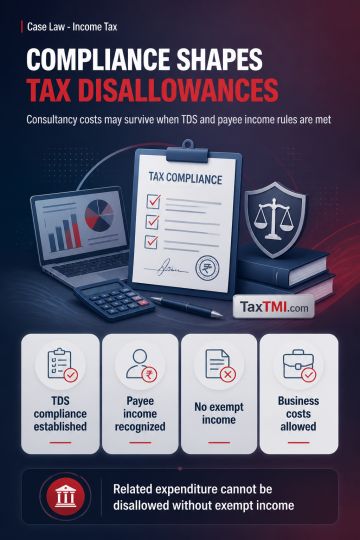
Tax deduction compliance and payee income recognition govern consultancy disallowance, while no exempt income prevents related expenditure disallowanc...
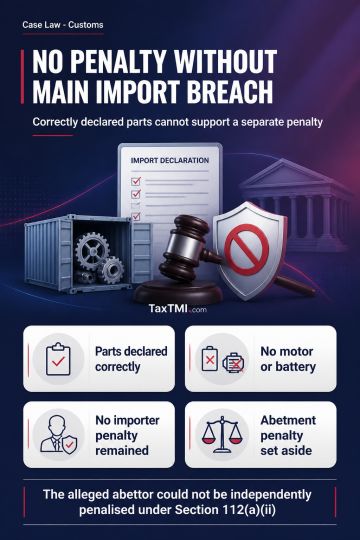
Derivative abetment liability fails when correctly declared imported components establish no underlying improper importation by the principal importer...
Tax exemption for regulatory authority income applies retrospectively, subject to non-commercial activity, unchanged income sources, and return filing...
Page of 4788
Press 'Enter' after typing page number.
361 to 380 of 95752 Results
❮
❯
❯❯
0 / 200
Expand Note
Add to Folder
No Folders have been created
+
Are you sure you want to delete "My most important" ?
In the present case, the Assessing Officer (AO) disallowed the expenditure claimed u/s 57(iii) of the Income Tax Act on an ad-hoc basis. The AO did not challenge the genuineness of the expenditure and acknowledged the submission of bills and vouchers. Section 57(iii) allows deduction of any expenditure incurred wholly and exclusively for earning income, provided it is not a capital expenditure. The AO did not contend that the expenditure was capital in nature. The assessee earned income from dispensing medicines, and the expenditure was incurred in relation to this income-earning activity. The AO did not doubt that the expenditure was not incurred for earning income. Relying on the Petroleum Sports Promotion Board case, the Appellate Tribunal held that the AO lacked jurisdiction to make an ad-hoc disallowance of 50% of the expenditure without pointing out any defect in the bills, vouchers, or ledgers. Consequently, the Tribunal directed the AO to delete the addition made, allowing the assessee's ground.
In the present case, the Assessing Officer (AO) disallowed the expenditure claimed u/s 57(iii) of the Income Tax Act on an ad-hoc basis. The AO did not challenge the genuineness of the expenditure and acknowledged the submission of bills and vouchers. Section 57(iii) allows deduction of any expenditure incurred wholly and exclusively for earning income, provided it is not a capital expenditure. The AO did not contend that the expenditure was capital in nature. The assessee earned income from dispensing medicines, and the expenditure was incurred in relation to this income-earning activity. The AO did not doubt that the expenditure was not incurred for earning income. Relying on the Petroleum Sports Promotion Board case, the Appellate Tribunal held that the AO lacked jurisdiction to make an ad-hoc disallowance of 50% of the expenditure without pointing out any defect in the bills, vouchers, or ledgers. Consequently, the Tribunal directed the AO to delete the addition made, allowing the assessee's ground.
Note: It is a system-generated summary and is for quick reference only.
 TaxTMI
 of 4788

















 Join Channel


 TaxTMI
