Business expenditure deduction requires proof of genuine commission payments and commercial allowability; turnover growth alone cannot validate the cl...
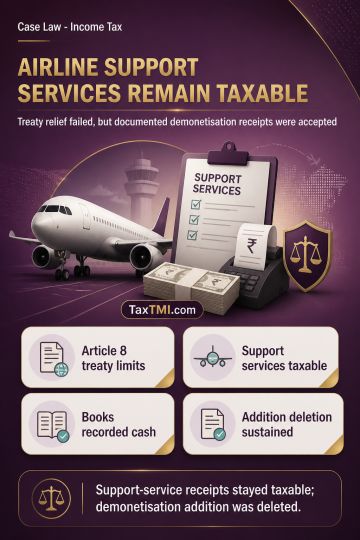
Article 8 treaty coverage excluded third-party airline support services, while documented demonetisation cash receipts remained accepted business inco...
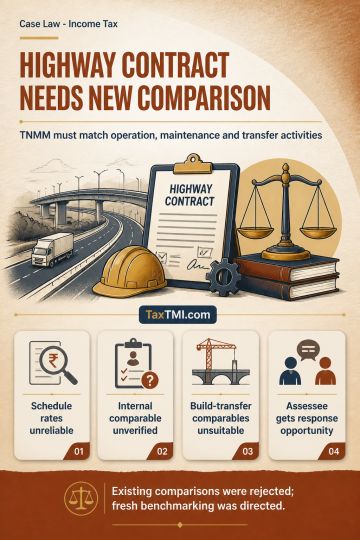
Functional comparability under TNMM requires highway contract benchmarks to reflect operation, maintenance and transfer activities, requiring fresh be...
In the present case, the Assessing Officer (AO) disallowed the expenditure claimed u/s 57(iii) of the Income Tax Act on an ad-hoc basis. The AO did not challenge the genuineness of the expenditure and acknowledged the submission of bills and vouchers. Section 57(iii) allows deduction of any expenditure incurred wholly and exclusively for earning income, provided it is not a capital expenditure. The AO did not contend that the expenditure was capital in nature. The assessee earned income from dispensing medicines, and the expenditure was incurred in relation to this income-earning activity. The AO did not doubt that the expenditure was not incurred for earning income. Relying on the Petroleum Sports Promotion Board case, the Appellate Tribunal held that the AO lacked jurisdiction to make an ad-hoc disallowance of 50% of the expenditure without pointing out any defect in the bills, vouchers, or ledgers. Consequently, the Tribunal directed the AO to delete the addition made, allowing the assessee's ground.
In the present case, the Assessing Officer (AO) disallowed the expenditure claimed u/s 57(iii) of the Income Tax Act on an ad-hoc basis. The AO did not challenge the genuineness of the expenditure and acknowledged the submission of bills and vouchers. Section 57(iii) allows deduction of any expenditure incurred wholly and exclusively for earning income, provided it is not a capital expenditure. The AO did not contend that the expenditure was capital in nature. The assessee earned income from dispensing medicines, and the expenditure was incurred in relation to this income-earning activity. The AO did not doubt that the expenditure was not incurred for earning income. Relying on the Petroleum Sports Promotion Board case, the Appellate Tribunal held that the AO lacked jurisdiction to make an ad-hoc disallowance of 50% of the expenditure without pointing out any defect in the bills, vouchers, or ledgers. Consequently, the Tribunal directed the AO to delete the addition made, allowing the assessee's ground.
Note: It is a system-generated summary and is for quick reference only.
 TaxTMI
 of 4784












 Join Channel


 TaxTMI
