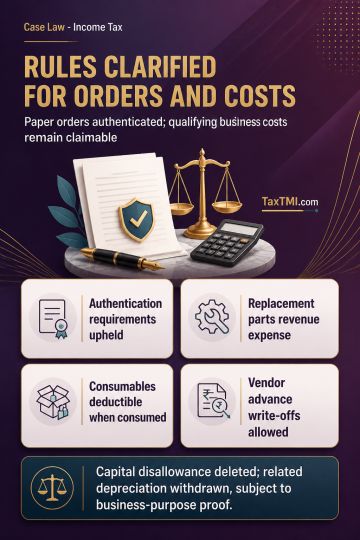
Authentication of paper assessment orders upheld, while qualifying repairs, consumables and vendor advance write-offs remain deductible business claim...
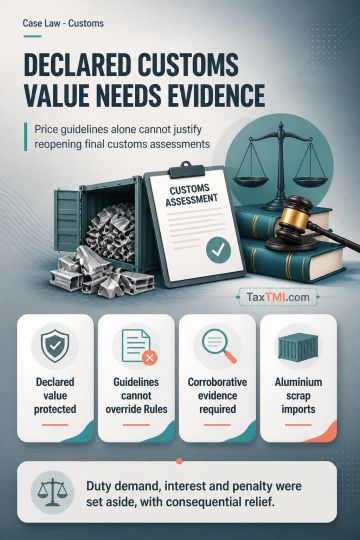
Transaction value cannot be rejected solely on non-statutory valuation guidelines without corroborative evidence supporting reassessment of final cust...
Cross-examination rights and corroborated evidence limit customs penalties for misdeclaration in genuine import transactions involving documented clea...
Page of 4780
Press 'Enter' after typing page number.
261 to 280 of 95596 Results
❮
❯
❯❯
0 / 200
Expand Note
Add to Folder
No Folders have been created
+
Are you sure you want to delete "My most important" ?
The High Court held that the limitation period prescribed in Section 153(3) of the Income Tax Act for issuing a fresh assessment order pursuant to an order u/s 254 (by the Appellate Tribunal) must be strictly construed. The Assessing Officer failed to comply with the Tribunal's remand order within the stipulated six-month period, and the statutory limitation period of nine months from the end of the financial year in which the Tribunal's order was received also expired. Passing a fresh assessment order beyond the statutorily prescribed limitation period is impermissible. Consequently, the impugned assessment order and notices were set aside, and the income returned by the assessee was accepted. The excess tax paid for the relevant assessment year must be refunded to the assessee.
The High Court held that the limitation period prescribed in Section 153(3) of the Income Tax Act for issuing a fresh assessment order pursuant to an order u/s 254 (by the Appellate Tribunal) must be strictly construed. The Assessing Officer failed to comply with the Tribunal's remand order within the stipulated six-month period, and the statutory limitation period of nine months from the end of the financial year in which the Tribunal's order was received also expired. Passing a fresh assessment order beyond the statutorily prescribed limitation period is impermissible. Consequently, the impugned assessment order and notices were set aside, and the income returned by the assessee was accepted. The excess tax paid for the relevant assessment year must be refunded to the assessee.
Note: It is a system-generated summary and is for quick reference only.
 TaxTMI
 of 4780






 Join Channel


 TaxTMI

