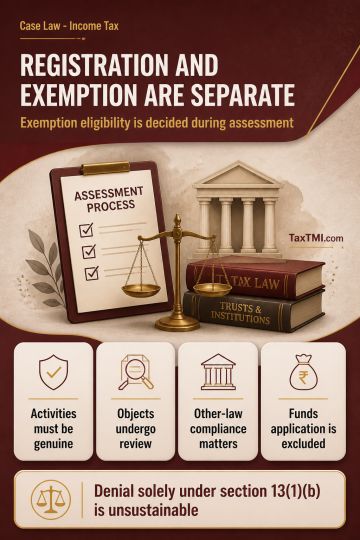
Defined public benefit can retain charitable character; registration renewal requires examining genuine activities and legal compliance, not surplus a...
Capital reduction is distinct from share buy-back, preventing buy-back tax; restructuring interest and related business deductions also survive scruti...
Transfer pricing and tax deductions upheld on established principles, while employee contributions and warranty provisions returned for fresh examinat...
Captive transfer pricing relies on industrial consumer tariffs, while genuine quotations can benchmark effluent treatment transfers under the Other Me...
Specific tariff classification for ophthalmic instruments and extended limitation principles determine the treatment of duty demands, confiscation, an...
Page of 4801
Press 'Enter' after typing page number.
1161 to 1180 of 96001 Results
❮
❯
❯❯
0 / 200
Expand Note
Add to Folder
No Folders have been created
+
Are you sure you want to delete "My most important" ?
The case pertains to the reopening of assessment u/s 147/148 of the Income Tax Act due to undisclosed cash deposits in the assessee's bank accounts. The key points are: The Assessing Officer (AO) had sufficient information to believe that the assessee's income had escaped assessment, justifying reopening u/s 147. The existence of tangible material forming the AO's belief is relevant, not its sufficiency at the reopening stage. The assessee did not file a return of income or participate in the reassessment proceedings. The assessee failed to explain the source of cash deposits. The Tribunal admitted additional evidence filed by the assessee regarding peak cash credits, requiring verification by lower authorities. The matter was remanded to the CIT(A) for readjudication on merits, as both assessment and appellate proceedings were ex-parte. The mandate is to bring the correct income to tax in the hands of the correct assessee for the correct assessment year.
The case pertains to the reopening of assessment u/s 147/148 of the Income Tax Act due to undisclosed cash deposits in the assessee's bank accounts. The key points are: The Assessing Officer (AO) had sufficient information to believe that the assessee's income had escaped assessment, justifying reopening u/s 147. The existence of tangible material forming the AO's belief is relevant, not its sufficiency at the reopening stage. The assessee did not file a return of income or participate in the reassessment proceedings. The assessee failed to explain the source of cash deposits. The Tribunal admitted additional evidence filed by the assessee regarding peak cash credits, requiring verification by lower authorities. The matter was remanded to the CIT(A) for readjudication on merits, as both assessment and appellate proceedings were ex-parte. The mandate is to bring the correct income to tax in the hands of the correct assessee for the correct assessment year.
Note: It is a system-generated summary and is for quick reference only.
 TaxTMI
 of 4801



















 Join Channel


 TaxTMI

