Tax exemption for specified legal-services authority income applies retrospectively, subject to non-commercial activity, unchanged income sources, and...
Approved resolution plans extinguish unsubmitted pre-approval tax claims, preventing later recovery outside the insolvency process and preserving a cl...
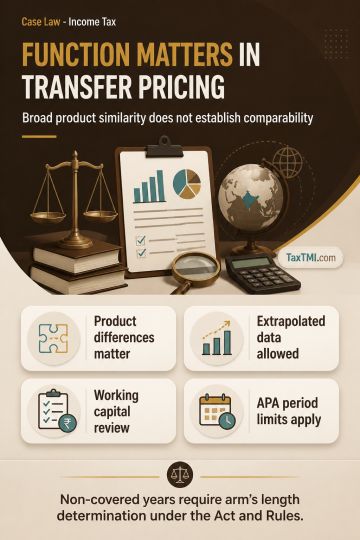
Transfer pricing comparability requires functional alignment and permits working capital adjustment, while APA margins cannot govern non-covered years...
Treaty benefit, goodwill depreciation and hedging costs: export commission disallowed, while key business deductions and depreciation claims succeeded...
Page of 4786
Press 'Enter' after typing page number.
601 to 620 of 95714 Results
❮
❯
❯❯
0 / 200
Expand Note
Add to Folder
No Folders have been created
+
Are you sure you want to delete "My most important" ?
The appellant, a customs broker, was found responsible for advising the importer to follow rules and regulations governing clearance of imported goods, and any non-compliance should have been brought to the customs authorities' notice. The appellant suggested the importer mis-declare the imported goods, described as "blank guns" which could have been modified into lethal weapons, to circumvent requirements under the Foreign Trade Policy and the Arms Act, 1959 read with the Arms Rules, 2016. The appellant had knowledge of such mis-declaration and mis-classification under CTH 9503 as "Blank Firing Guns," requiring a DGFT license under the import policy and a license under the Arms Act. The factual findings led to the forfeiture of the security deposit. As the case involved only factual findings, no substantial questions of law arose, and the appeal was dismissed.
The appellant, a customs broker, was found responsible for advising the importer to follow rules and regulations governing clearance of imported goods, and any non-compliance should have been brought to the customs authorities' notice. The appellant suggested the importer mis-declare the imported goods, described as "blank guns" which could have been modified into lethal weapons, to circumvent requirements under the Foreign Trade Policy and the Arms Act, 1959 read with the Arms Rules, 2016. The appellant had knowledge of such mis-declaration and mis-classification under CTH 9503 as "Blank Firing Guns," requiring a DGFT license under the import policy and a license under the Arms Act. The factual findings led to the forfeiture of the security deposit. As the case involved only factual findings, no substantial questions of law arose, and the appeal was dismissed.
Note: It is a system-generated summary and is for quick reference only.
 TaxTMI
 of 4786













 Join Channel


 TaxTMI