Just a moment...

Top
Help
×

By creating an account you can:

Logo TaxTMI
>
Call Us / Help / Feedback

Contact Us At :

E-mail: [email protected]

Call / WhatsApp at: +91 99117 96707

For more information, Check Contact Us

FAQs :

To know Frequently Asked Questions, Check FAQs

Most Asked Video Tutorials :

For more tutorials, Check Video Tutorials

Submit Feedback/Suggestion :

Email :
Please provide your email address so we can follow up on your feedback.
Category :
Description :
Min 15 characters0/2000
Add to...
You have not created any category. Kindly create one to bookmark this item!
Create New Category
Hide
Title :
Description :
❮❮ Hide
Default View
Expand ❯❯
Close ✕
🔎 Highlights - Adv. Search
TEXT SEARCH:

Press 'Enter' to add multiple search terms. Rules for Better Search

Search In:
Main Text + AI Text
  • Main Text
  • Main Text + AI Text
  • AI Text
Law:
---- All Laws----
  • ---- All Laws----
  • Income Tax
  • Direct Taxes
  • Benami Property
  • Central GST Laws
  • SGST - State GST Laws
  • Customs
  • FTP - Foreign Trade Policy
  • SEZ - Special Economic Zone
  • FEMA - Foreign Exchange Management
  • Companies Law
  • SEBI - Securities & Exchange Board of India
  • IBC - Insolvency and Bankruptcy
  • Law of Competition
  • PMLA - Money-Laundering
  • Indian Laws
  • Bill / Finance Bills
  • Wealth Tax
  • Service Tax
  • Central Excise
  • VAT / Sales Tax
Month:
---- All Months ----
  • ---- All Months ----
  • January
  • February
  • March
  • April
  • May
  • June
  • July
  • August
  • September
  • October
  • November
  • December
Year:
---- All Years ----
  • ---- All Years ----
  • 2026
  • 2025
  • 2024
  • 2023
  • 2022
  • 2021
  • 2020
  • 2019
  • 2018
  • 2017
  • 2016
  • 2015
  • 2014
  • 2013
  • 2012
  • 2011
Sort By: ?
In Sort By 'Default', exact matches for text search are shown at the top, followed by the remaining results in their regular order.
RelevanceDefaultDate
    Interest on self-assessed tax must be determined before garnishee recovery where Electronic Cash Ledger adjustment representations remain undecided.
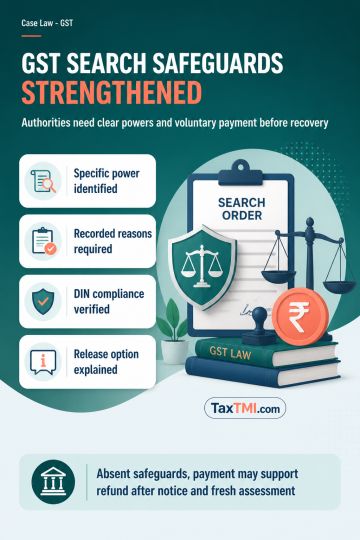
    GST search safeguards require clear authorisation, verifiable DIN compliance, and genuinely voluntary pre-notice tax payments before recovery.
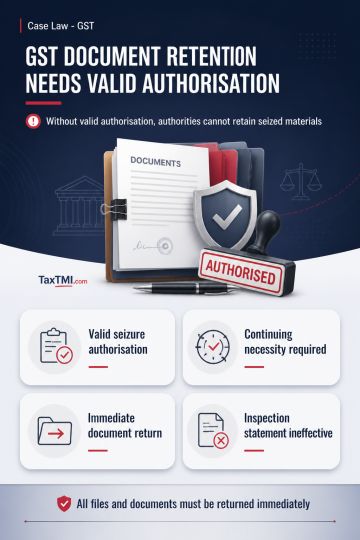
    Retention of seized GST documents requires valid authorisation; withdrawal removes the basis for retention and requires their return.
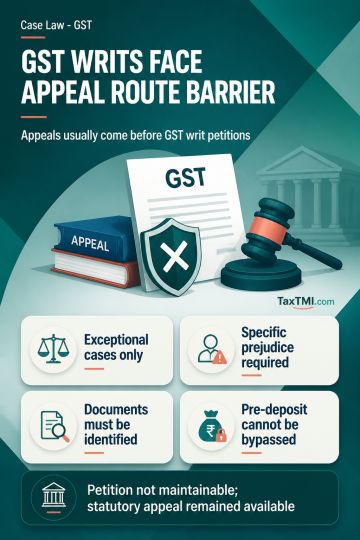
    Alternative statutory remedy restricts GST writ challenges unless specific natural justice prejudice establishes an exceptional case.
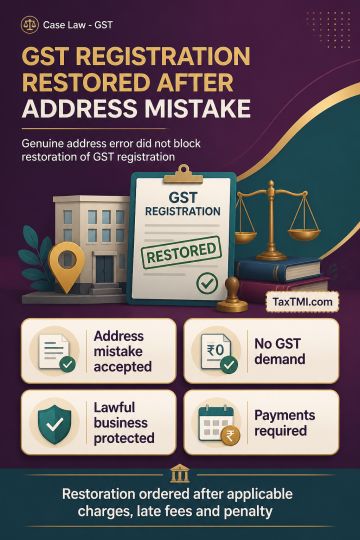
    GST registration restoration for a genuine address discrepancy was granted subject to payment of applicable charges, late fees and penalty.
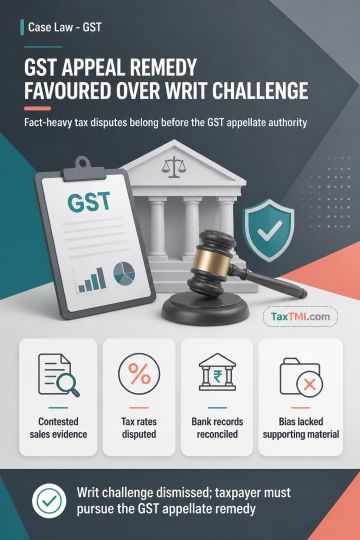
    Alternative GST remedy prevails where demand disputes require factual examination and alleged inspection-authorisation bias lacks supporting material.
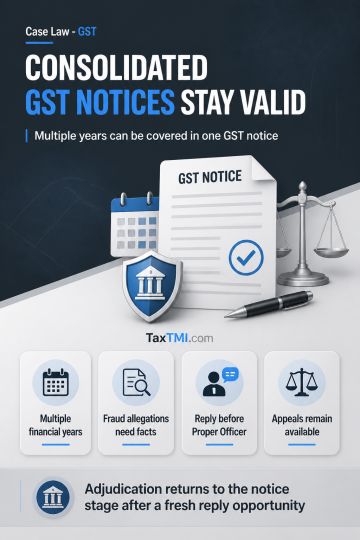
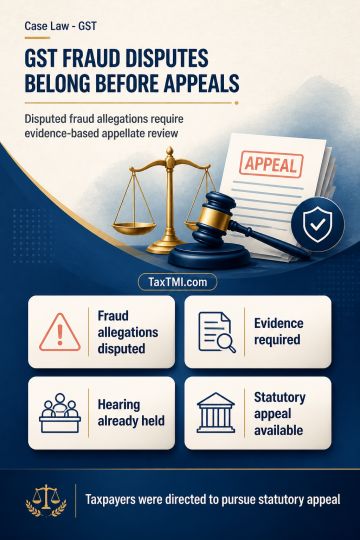
    Consolidated GST show cause notices remain valid, while fraud-based demand allegations require factual adjudication through statutory remedies.
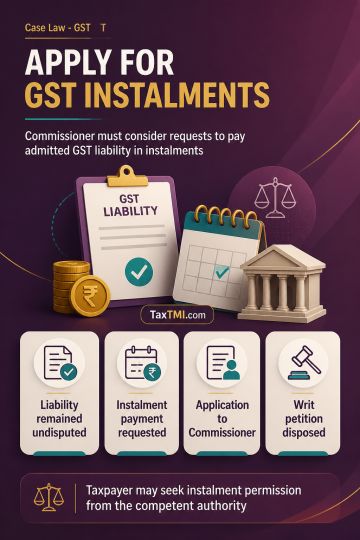
    Instalment payment of admitted GST liability requires application to the Commissioner, who must consider the request under law.
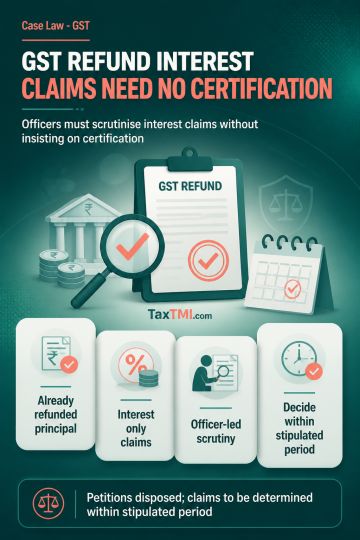
    Interest on delayed GST refunds may be scrutinised without Chartered Accountant certification where only refunded principal interest is claimed.
    Disputed factual allegations in GST fraud claims require statutory appellate review rather than writ adjudication.
    Electronic credit ledger restrictions require review when Rule 86A conditions no longer exist, enabling consideration of unblocking applications.
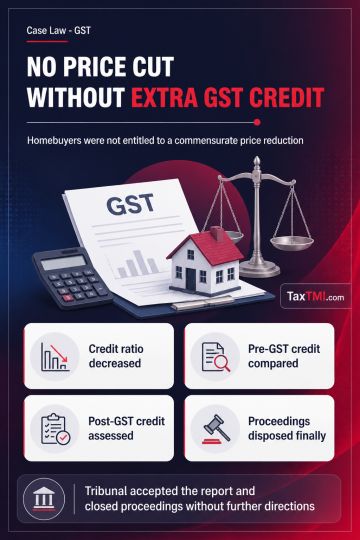
    Additional input tax credit benefit was absent, so homebuyers were not entitled to a commensurate price reduction under anti-profiteering rules.
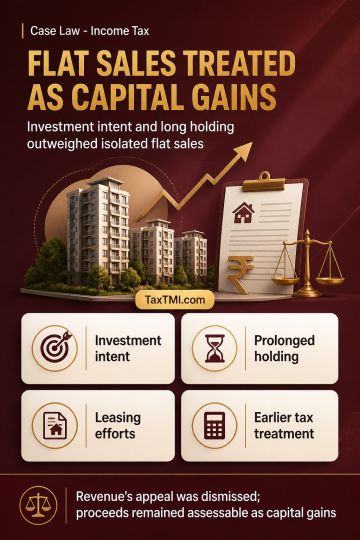
    Capital gains classification upheld where investment intent, prolonged holding and consistent prior tax treatment outweighed isolated flat sales.
    Restricted government grants remain non-income, while block depreciation applies despite retirement of individual business assets from active use.
    Revisionary jurisdiction is barred for appealed purchase issues and cannot replace a plausible assessment after inquiry.
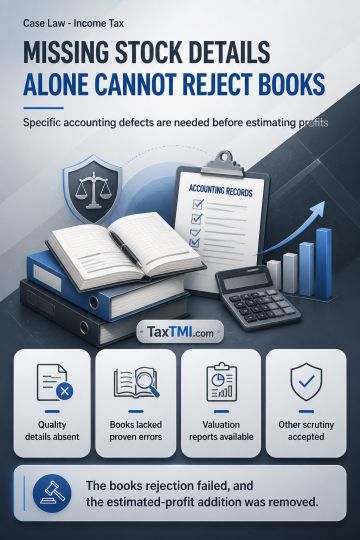
    Rejection of Books Requires Specific Accounting Defects; missing quality-wise stock details alone cannot support estimated-profit additions.
    Foreign tax credit for partnership legal-service receipts remains available where overseas income is taxed in India and documented.
    Commercial vehicle depreciation, scientifically determined warranty provisions and exempt-income disallowances were resolved in favour of the taxpayer...
    Explained foreign life-insurance investments remain outside undisclosed-asset taxation, while foreign insurer maturity proceeds qualify for exemption.
    Section 80P deduction for deposit income and strict reassessment limitation determine the treatment of consequential penalty proceedings.
❯❯
MaximizeMaximizeMaximize
0 / 200
Expand Note
Add to Folder

No Folders have been created

    +

    Are you sure you want to delete "My most important" ?

    NOTE:

    Highlights
    Showing Results for :
    Reset Filters
    Results Found:
    Show All SummariesHide All Summaries

    Highlights

    Back

    All Highlights

    Showing Results for :
    Reset Filters
      No Records Found

      Highlights

      Back

      All Highlights

      whatsappJoin Channel
      Showing Results for : Reset Filters

      The doctrine of prospective overruling is applied when a...

      Indian Supreme Court Uses Prospective Overruling to Alter Tax Rules, Stagger Payments, Waive Penalties for Past Demands.

      Contents
      Summary
      Note

      Note

      -

      Bookmark

      Print

      Print

      Indian LawsAugust 21, 2024Case LawsSC
      The doctrine of prospective overruling is applied when a constitutional court overrules a well-established precedent by declaring a new rule but limits its application to future situations to avert injustice or hardships. The US Supreme Court has considered the existence of a statute or judicial decision as an "operative fact" having consequences that cannot be ignored, and the effect of a subsequent ruling on invalidity must be considered in light of various aspects. The Indian Supreme Court has adopted this doctrine, partly inspired by US jurisprudence. In cases like Golakh Nath v. State of Punjab and Jindal Stainless Ltd. v. State of Haryana, the Court applied the doctrine. Considering the substantial amount of tax demands and the delay in proceedings, the Court held that while states may levy or renew demands pertaining to Entries 49 and 50 of List II, the demand shall not operate on transactions prior to April 1, 2005. The payment of tax demand shall be staggered over twelve years from April 1, 2026, and the levy of interest and penalty on demands before July 25, 2024, shall stand waived.

      Topics

      ActsIncome Tax