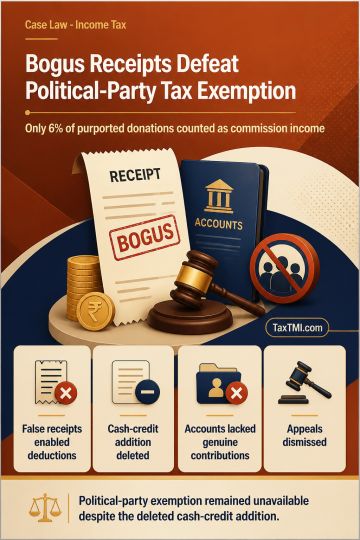
Bogus donation receipts justified commission income assessment and defeated political-party tax exemption for inaccurate accounts and reporting failur...
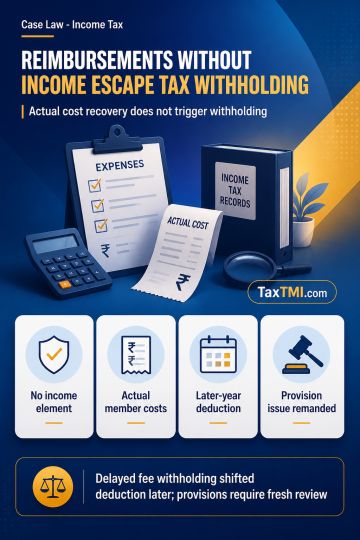
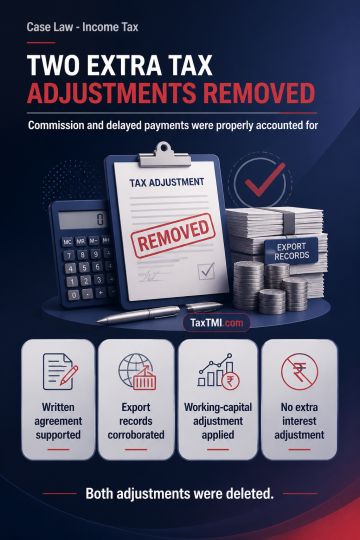
Pure reimbursement without income element escapes tax withholding, while delayed withholding and unsupported provisions face deferred or renewed scrut...
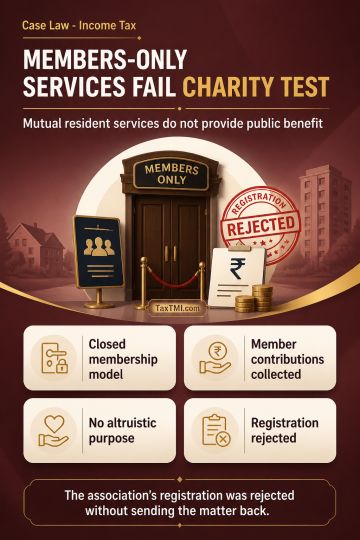
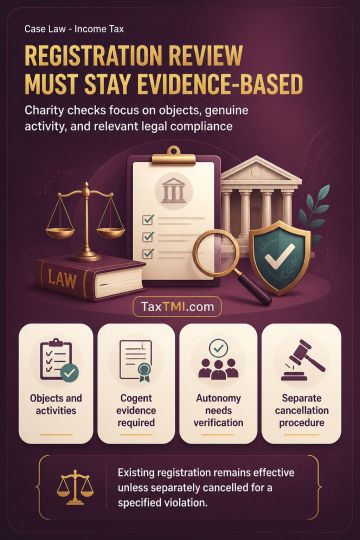
Public benefit requirement defeats charitable registration where residents' association services are reciprocal, member-only facilities governed by mu...
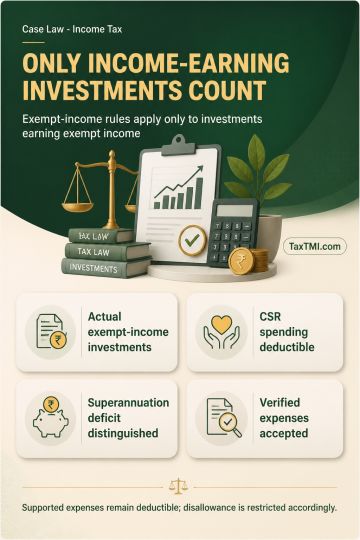
Exempt-income expenditure disallowance is confined to investments that actually generated exempt income, while supported business expenses remain dedu...
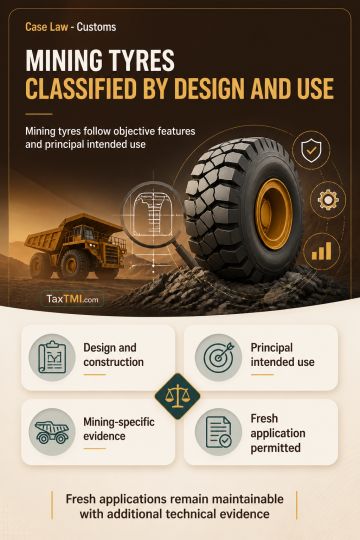
Objective characteristics and principal use govern mining-tyre classification, while fresh advance ruling applications may rely on additional technica...
Page of 4805
Press 'Enter' after typing page number.
801 to 820 of 96092 Results
❮
❯
❯❯
0 / 200
Expand Note
Add to Folder
No Folders have been created
+
Are you sure you want to delete "My most important" ?
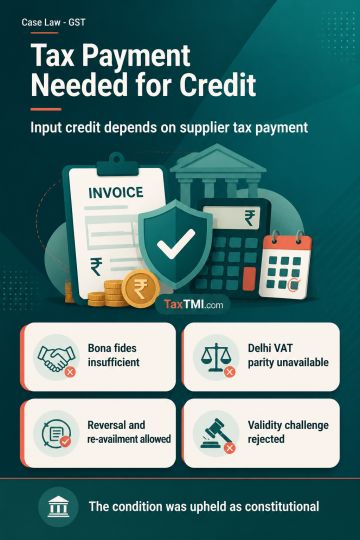
Validity of input tax credit (ITC) u/s 16 of the UP GST Act hinges on compliance with specified conditions to avoid double taxation. The burden lies on the dealer to prove fulfillment of conditions for claiming ITC. Merely producing tax invoices, e-way bills, and banking channel payments is insufficient. Proof of actual physical movement of goods, genuineness of transportation, payment of freight charges, acknowledgment of delivery, toll receipts, and filing of GSTR 2A is necessary. The Supreme Court has held that the primary burden is on the dealer to furnish details like selling dealer, vehicle number, freight payment, delivery acknowledgment, tax invoices, and payment particulars to establish actual goods movement. Submitting only invoices, e-way bills, or payment details is inadequate. Consequently, the High Court dismissed the writ petition, upholding the orders denying ITC for non-compliance with statutory conditions.
Validity of input tax credit (ITC) u/s 16 of the UP GST Act hinges on compliance with specified conditions to avoid double taxation. The burden lies on the dealer to prove fulfillment of conditions for claiming ITC. Merely producing tax invoices, e-way bills, and banking channel payments is insufficient. Proof of actual physical movement of goods, genuineness of transportation, payment of freight charges, acknowledgment of delivery, toll receipts, and filing of GSTR 2A is necessary. The Supreme Court has held that the primary burden is on the dealer to furnish details like selling dealer, vehicle number, freight payment, delivery acknowledgment, tax invoices, and payment particulars to establish actual goods movement. Submitting only invoices, e-way bills, or payment details is inadequate. Consequently, the High Court dismissed the writ petition, upholding the orders denying ITC for non-compliance with statutory conditions.
Note: It is a system-generated summary and is for quick reference only.
 TaxTMI
 of 4805



 Join Channel


 TaxTMI