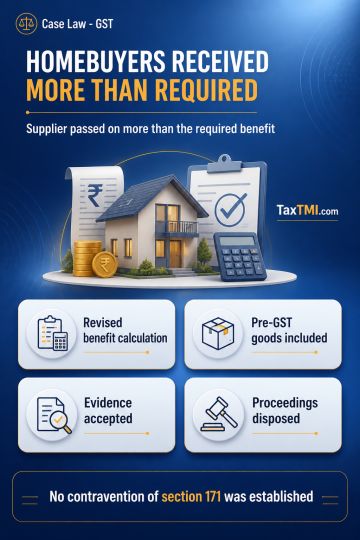
Necessary-party requirements limit impleadment of independent entities, while deferred consideration does not create an appealable adverse determinati...
Food supplement classification requires common parlance and authoritative tests, preventing treatment as proprietary Ayurvedic medicines without suppo...
Specified regulatory authority income receives conditional tax exemption, subject to non-commercial activity, unchanged income character, and return f...
Tax exemption for regulatory authority income applies retrospectively, subject to non-commercial activity, unchanged income sources, and return-filing...
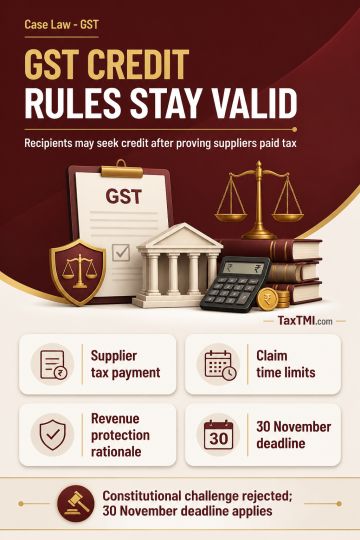
Input tax credit conditions remain constitutionally valid, with eligible recipient claims considered under GST circulars and retrospective filing dead...
Validity of input tax credit (ITC) u/s 16 of the UP GST Act hinges on compliance with specified conditions to avoid double taxation. The burden lies on the dealer to prove fulfillment of conditions for claiming ITC. Merely producing tax invoices, e-way bills, and banking channel payments is insufficient. Proof of actual physical movement of goods, genuineness of transportation, payment of freight charges, acknowledgment of delivery, toll receipts, and filing of GSTR 2A is necessary. The Supreme Court has held that the primary burden is on the dealer to furnish details like selling dealer, vehicle number, freight payment, delivery acknowledgment, tax invoices, and payment particulars to establish actual goods movement. Submitting only invoices, e-way bills, or payment details is inadequate. Consequently, the High Court dismissed the writ petition, upholding the orders denying ITC for non-compliance with statutory conditions.
Validity of input tax credit (ITC) u/s 16 of the UP GST Act hinges on compliance with specified conditions to avoid double taxation. The burden lies on the dealer to prove fulfillment of conditions for claiming ITC. Merely producing tax invoices, e-way bills, and banking channel payments is insufficient. Proof of actual physical movement of goods, genuineness of transportation, payment of freight charges, acknowledgment of delivery, toll receipts, and filing of GSTR 2A is necessary. The Supreme Court has held that the primary burden is on the dealer to furnish details like selling dealer, vehicle number, freight payment, delivery acknowledgment, tax invoices, and payment particulars to establish actual goods movement. Submitting only invoices, e-way bills, or payment details is inadequate. Consequently, the High Court dismissed the writ petition, upholding the orders denying ITC for non-compliance with statutory conditions.
Note: It is a system-generated summary and is for quick reference only.
 TaxTMI
 of 4805
















 Join Channel


 TaxTMI